
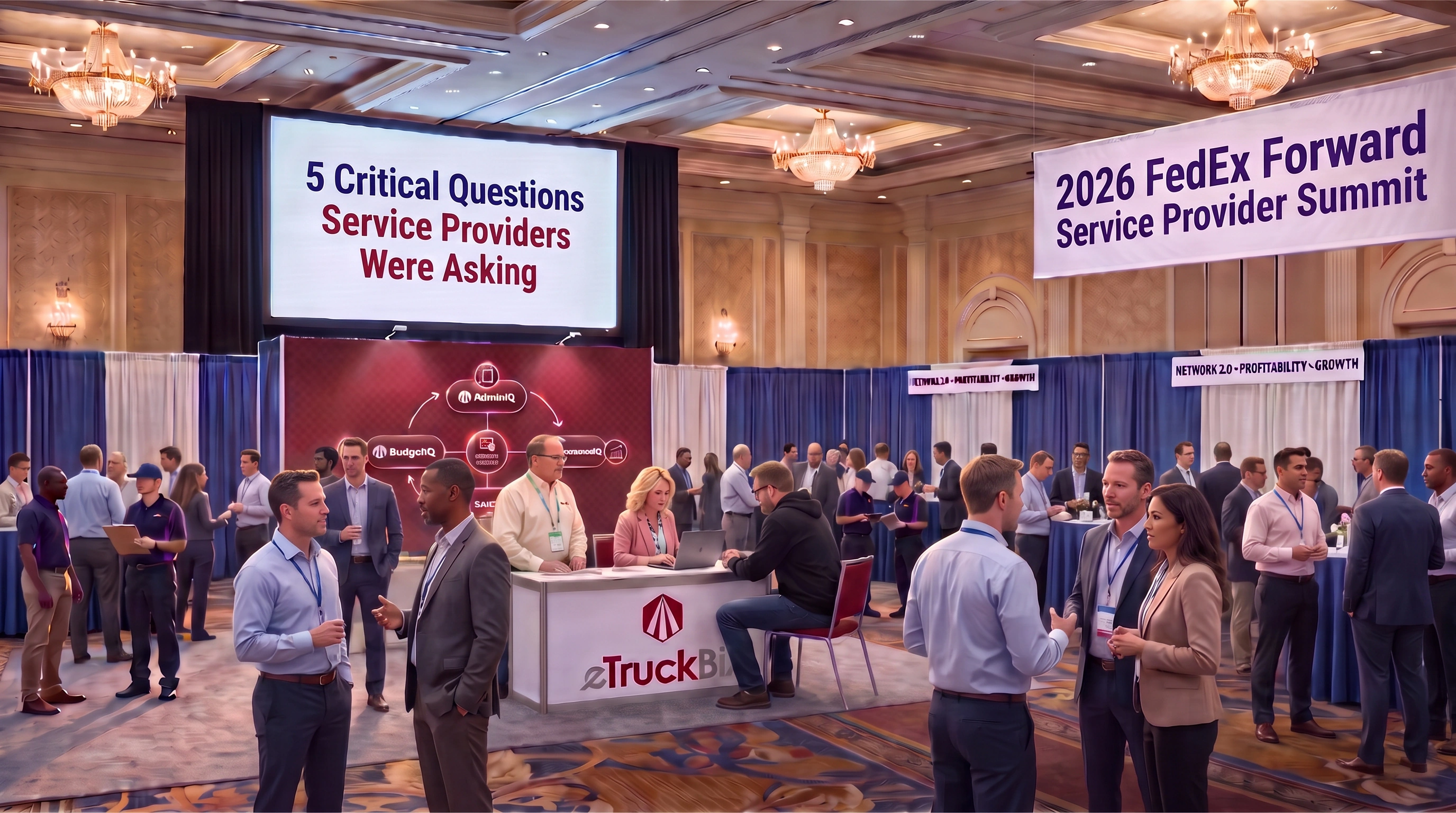
We just got back from the 2026 FedEx Forward Service Provider Summit in Orlando and hats off to FedEx for putting it on. The Summit ran October 5–8 at the Hyatt Regency and brought Service Providers together with FedEx leaders, subject matter experts, and the vendors who support this industry. Events like this matter because they get the strategy and the vision out of corporate and into the hands of the people who actually run the businesses. In the day-to-day grind, that vision is the first thing that gets lost. Just as valuable is the chance for contractors to talk to each other and to the people who build the tools they use. That conversation does not happen in a terminal at 5:30 in the morning.
This year the buzz on the floor had two layers. The first was expected: the remaining Network 2.0 integration and everything that surrounds it. FedEx is running about 45% of eligible volume through nearly 490 Network 2.0-optimized stations, is pushing toward 65% before peak, and will pause integration through peak before resuming in early 2027 (FedEx Q4 FY2026 earnings call). More than 200 stations have closed with 475-plus targeted by the end of 2027, roughly 30% of the facility footprint (Supply Chain Dive). Everyone at the Summit had an opinion about that.
The second layer was quieter, and it was new. More Service Providers than we have ever heard are saying some version of the same thing: margins have deteriorated over the last seven to ten years, especially on the P&D side, Network 2.0 has made the business much more complicated than it used to be, and somewhere along the way they stopped running their business and started working in it.
Here is the thing, though. The most useful part of the Summit for us was not what was on the agenda. It was what you asked us at the booth. Over three days, the same five questions came up again and again, from seven-route operators and from multi-station Gold contractors alike. This post answers them the way we answered them in Orlando, with the numbers attached.
The five questions:
- Are people actually seeing better margins in Network 2.0?
- Is the number of contractors FedEx uses really decreasing, and why?
- What can be done about the recruiting and retention problem?
- How do I get out of being trapped in my business?
- Does eTruckBiz help if I want to put a full plan in place to recover my business?
Question 1: Are People Seeing Better Margins in Network 2.0?
Yes. But only the people who approached the change on purpose and embraced it, rather than waiting for it to happen to them.
Start with why margins compressed in the first place, because Network 2.0 gets blamed for a problem that started earlier. Cumulative U.S. inflation from 2016 to 2026 is roughly 40%, meaning $100 of 2016 expenses now costs about $140 (in2013dollars, BLS CPI data). Vehicles, insurance, parts, wages, and fuel all moved, and most moved faster than the headline number. At the same time the ecommerce density-stop push lowered revenue per stop across the business. Contract revenue did not keep pace in most markets. That squeeze was already in place before the first Express package landed in a Ground van.
What Network 2.0 changes is density. FedEx has reported that pickup-and-delivery cost is down about 10% in markets where the model has rolled out (Supply Chain Dive), and management credits the program with "better density and efficiency" across the surface network (FedEx Q4 FY2026 earnings call). Read that as a contractor and it means more stops per mile in your service area. Density is the single most powerful lever in P&D economics, because it raises stops per dispatch without raising the cost of the dispatch. Operations in optimized markets are already trading at higher values for exactly that reason (Route Advisors).
Density only turns into margin if you re-engineer the operation to capture it. That is where the two camps separate. Here is an illustrative example with round numbers.
A 12-route operation runs 95 stops per dispatch before integration, 1,140 stops a day. Network 2.0 lands in the station and daily stops rise 15% to 1,311. Owner A re-engineers the service area, resets the stops-per-dispatch target, retrains drivers on the new mix, and runs the volume on the same 12 dispatches at about 109 stops each. Owner B does what feels safe, adds a thirteenth route, and runs about 101 stops per dispatch. Both deliver every package. Both get the same settlement.
Owner B puts one more vehicle on the road every day. At a conservative $300 per dispatch in loaded driver wages, fuel, maintenance, and vehicle wear, that is $300 a day for about 260 operating days, or $78,000 a year. On a $1,500,000 operation, that is 5.2 points of margin. Owner A is now the contractor telling you margins are better in Network 2.0. Owner B is the contractor telling you Network 2.0 ruined the business. Same station, same packages, same contract. The difference is how they approached the change.
We see this in our own client base. Several of our clients are running 10%, 12%, and better operating margins in integrated stations, and the pattern is consistent: they treat every dispatch as a financial decision, they know their stops-per-dispatch target, and they stopped adding routes as the default answer to more volume (eTruckBiz). Margins are better in Network 2.0 for the people who manage to the density. They are worse for everyone else, and that gap is widening.
Question 2: Is the Number of Contractors FedEx Uses Actually Decreasing, and Why?
Yes, and faster than most people realize.
The numbers come straight from FedEx's own filings. In 2023, Federal Express contracted with nearly 7,000 independent businesses for pickup, delivery, and linehaul. By May 2024 that was about 6,000, by May 2025 about 5,700, and as of May 31, 2026, approximately 5,300 (eTruckBiz; FedEx FY2026 10-K). That is roughly 1,700 contractor businesses gone in three years, a 24% reduction, while the packages did not go anywhere. They are being delivered by the contractors who are left.
Why is it happening? Four reasons stack on top of each other.
- Station closures redraw the map. When a station closes and its volume moves to a consolidated facility, Contracted Service Areas get redefined. Some contractors gain, some lose, and some are left without a service area that makes sense to operate.
- The medals program sorts the field. Gold and Silver contractors earn the opportunity to negotiate new agreements and a right of first acceptance; Bronze contractors are more likely to lose service areas (FreightWaves; Transport Topics). Over time, that mechanism moves volume from the bottom of the field to the top.
- Owners are choosing to leave. This is the reason nobody puts in a filing. Margins compressed, the job got harder, and a lot of good people who felt trapped decided to sell rather than fight through another peak. That is Question 4, and it is as much a driver of the count as anything FedEx did.
- They are thinning the herd. As we have been communicating for years, the business is changing and those who are not embracing the change are finding the door, whether they want to or not. This is quietly happening everyday, pre and post integration.
What does the field look like on the other side? Fewer, much larger contractors. Multi-CSA and multi-station operations become the norm. Our own projection is somewhere in the range of 3,500 to 4,000 Service Providers by 2031, once the rollout finishes in 2027 and the operational shakeout runs its course (eTruckBiz). If that is roughly right, about one in three of the contractors operating today will not be operating in five years. The practical question for every owner is simple: are you going to be the one acquiring the neighbor's service area, or the neighbor? Gold status, a system that scales, and margins that can absorb the next change are what put you in the first group.
Question 3: What Can Be Done About the Recruiting and Retention Problem?
This was the most emotional question at the booth, and the one with the most money hiding in it.
Start with the size of the problem. Industry data puts the cost of replacing a single delivery driver at $3,000 to $7,000 once you count recruiting, background checks, drug testing, training, the productivity dip while a new driver learns the route, and the elevated accident risk that comes with it. Roughly 35 to 40% of new hires leave within their first 90 days (Heavy Duty Journal). Annual separation rates in transportation and warehousing regularly exceed 40%, with last-mile running higher.
Put that on a 20-driver operation at 60% annual turnover, which is common in this business. That is 12 replacements a year at a $5,000 midpoint, or $60,000 a year spent replacing people, before you count the service failures, the owner covering the open route, and the Business Contact who spends half the week interviewing instead of managing. Cut turnover to 30% and you save $30,000 a year and get your BC back. Retention is not an HR issue. It is a margin line.
Let's also be honest about the labor pool, because every contractor at the booth was. Every generation complains about the one behind it, and nearly every industry in the country is saying the same thing at the same time, which suggests something real is going on. Many young workers genuinely do not see what hard work can build. You can argue about why. What you cannot do is build an operation that depends on finding twelve drivers who think the way you did at 24. The labor pool is what it is, which means your system has to carry more of the load than it did ten years ago. That is a design requirement, not a grievance.
So what actually works? The contractors with the lowest turnover we see share these habits:
- They fix the Business Contact first. The failure chain in almost every struggling operation starts with a BC who cannot lead. Drivers do not quit the job; they quit the person running it. A BC with real authority, clear limits, and experienced support behind them is the single biggest retention lever there is.
- They win or lose the driver in the first 90 days. Methods training, realistic expectations about the Express and Ground mix, a defined ramp-up, and a check-in cadence. Nearly 40% of turnover happens before day 90, so that is where the structure goes.
- They make pay transparent. The operations with the lowest turnover share one trait: drivers trust the pay system because they can see exactly how it is calculated. Payroll disputes are a leading cause of early exits, and they are entirely preventable.
- They give drivers a target, not just a manifest. When the whole operation knows the stops-per-dispatch number it is running to, drivers understand what a good day looks like, and good drivers like knowing they had one.
- They stop asking the owner to recruit. An owner who is personally posting ads, screening applicants, and chasing paperwork is an owner who is not running the business. Move the administrative side of hiring, onboarding paperwork, payroll, and timekeeping off the owner's desk and onto a system and a team built for it.
Recruiting will stay hard. Retention is where the money is, and retention is a management-system outcome.
Question 4: How Do I Get Out of Being Trapped in My Business?
This question usually came at the end of a longer conversation, after the margin and driver questions, and it was usually asked quietly.
Name the feeling honestly, because most contractors never do. Being trapped feels like waking up already behind. It is dread when the phone buzzes before 6:00 a.m. because you already know it is a call-out. It is being the highest-paid driver and the lowest-paid executive in your own company. It is resentment toward a business you were once proud of, and guilt about the resentment. It is isolation, because your spouse does not understand why you cannot leave the terminal, your drivers see you as the fill-in guy, and your station leadership sees you as a problem to be managed rather than a partner to be respected.
The data says this is not a FedEx-only phenomenon. In Bluevine's 2026 survey of U.S. small business owners, 53% said financial stress left them emotionally drained or burned out in the past year and 62% reduced or skipped their own pay at least once to cover business costs (Bluevine). Xero found 40% of U.S. small business owners have considered giving up their business entirely (Xero). Those are capable people whose businesses outgrew the way they were running them.
Here is the principle underneath it: a business that depends on the owner's hours is a job, and a business that runs on a system is an asset. The owner's hours do not scale, do not compound, and cannot be sold. When Network 2.0 multiplied the number of decisions in a day and the system for making them stayed the same, the owner became the system. That is the trap, and it is a design problem, not a character flaw.
Does it have to be this way? At our booth we noticed more Gold operators than in years past. These are contractors who went through the biggest operational change in FedEx history and came out holding the top tier. The ones we know got out of the trap the same way:
- They run on daily data, not instinct alone: stops per dispatch, driver hours, maintenance exposure, and safety events every day, not when the books close.
- They replaced the spreadsheet and the group text with a system of record the business owns, so the operation has a memory that is not the owner's phone.
- They walked outside their comfort zone on purpose: a new dispatch method, a BC with real leadership skills, a budget they answer to. That willingness to be uncomfortable is the sign of a true entrepreneur.
- They borrowed experience rather than earning every scar, tapping the lessons of the Service Providers who blazed the trail ahead of them, through a trusted source that can tell them which lesson applies. In the internet and AI age, that is harder to find, not easier.
And here is what the other side feels like, because trapped owners rarely let themselves imagine it. You take a real vacation and the phone stays quiet. You walk into the station and the senior manager asks your opinion instead of handing you a list. Your spouse stops asking when it will get better, because it already did. Your drivers call you the boss, not the sub. Other contractors come to you for advice in Orlando. Your banker returns calls, and a buyer who asks about your numbers gets a report instead of a story, and the price goes up accordingly. That is pride, and it is earned. Nobody admires the owner who is drowning. Everybody notices the one who is not. The business did not change your standing with your family, your station, or your peers. The way you ran it did, which means the way you run it can change it back.
Question 5: Does eTruckBiz Help If I Want a Full Plan to Recover My Business?
Yes. This is exactly what we built the Business Growth & Support System to do, and for operations that are already in trouble we run it as a sequenced Service Provider Recovery Plan rather than a menu of tools.
Here is how it works. It starts with an onsite PerformanceIQ assessment, typically within days and at most a couple of weeks, so the plan is built on what is actually happening in your station and not on what the spreadsheet says. From there the plan runs in four phases:
- Stabilize. Get the open work areas covered, get the owner out of the truck, and put daily operations review and dispatch engineering in place so the bleeding stops this week, not next quarter.
- Rebuild. Evaluate the Business Contact honestly, support or replace as needed with BC Assist behind them, and put the first-90-day driver structure in place so the people you hire stay.
- Control. Move administration, payroll, and timekeeping off the owner's desk with AdminIQ, bring safety under SafetyIQ with VEDR coaching and documentation, and put a real budget and dispatch-yield review in place with BudgetIQ.
- Prevent. Run the operation to a published stops-per-dispatch target, review leading indicators weekly, and build the reporting that makes you Gold-tier in the station's eyes and bankable in a buyer's.
Everything runs on one platform, BOSS, and you get one account owner accountable for the number, backed by an onshore administrative team, a financial analyst, and a safety program lead. The programs are priced as a percentage of your revenue, so our economics track your operating scale. Hundreds of FedEx Service Providers run their businesses on this system today, and the ones who came to it in recovery mode will tell you the first thing that changed was not a metric. It was that somebody was finally in the office watching the operation, so they did not have to be.
If your situation is not recovery but growth, the same system is what the Gold operators at the booth are using to acquire the neighbor's service area without the owner's hours doubling. Either way, the first step is the same: a Working Session where we look at your numbers, your hours, and your station and tell you honestly what the plan looks like.
Putting It Together: Five Answers, One Plan
- Manage to the density. Network 2.0 raises stops per mile. Reset your stops-per-dispatch target, re-engineer the service area, and stop adding routes as the default answer to more volume. That is the entire difference between Owner Gold and Owner Bronze.
- Decide which side of the consolidation you are on. The count is going from 5,300 toward 3,500 to 4,000. Gold status, scalable systems, and margins that absorb change put you on the acquiring side.
- Treat retention as a margin line. Fix the BC, structure the first 90 days, make pay transparent, give drivers a target, and get the owner out of the recruiting chair.
- Replace your hours with a system. Daily data, a system of record, a BC who can run the day, and borrowed experience. That is how the Gold operators got out of the trap.
- Get a sequenced plan, not a silver bullet. Stabilize, rebuild, control, prevent, with one accountable owner for the number. Recovery is a sequence, not a tool.
The Bottom Line
The next twelve months bring the second half of Network 2.0, a peak season under the new model, and another year of costs that are not going back down. The contractors who asked us these five questions in Orlando were really asking one question: is there a way through this that ends with a business worth owning? There is, and the Gold operators standing next to them at the booth were the proof. Margins are better for the people who manage to the density. The field is shrinking toward the people who build systems. Retention follows management. The trap opens when the owner's hours stop being the system. And there is a plan for all of it.
eTruckBiz Inc. works with FedEx Contracted Service Providers to put that plan in place, from an onsite assessment and daily operations review to administration, budgeting, and safety, all on one platform with one accountable account owner. If one of these five questions was yours, schedule a Working Session with our team and we will answer it with your numbers. The Right Service Provider Support, Right Now.