Driver turnover is climbing across the FedEx Service Provider base, and the timing could not be worse. Our eTruckBiz data shows Service Provider driver turnover running 30–40% annually, with roughly a third of new hires gone before they reach the 90-day mark. That is consistent with the broader sector — Bureau of Labor Statistics JOLTS data shows annual separation rates in transportation and warehousing regularly exceeding 40%. The difference for you is that a national statistic is an abstraction and your roster is not.
Two things are converging right now. First, Network 2.0. FedEx has implemented the new model at roughly 360 locations, has closed more than 200 stations with 475-plus targeted by the end of 2027, and expects 65% of eligible daily volume to run through optimized facilities by the time this peak season hits. Many contractors have not been integrated yet. For those who have, the integration itself — new start times, reworked CSAs, new operational demands, and in some cases, new leadership — has been generating turnover on its own. Change is a resignation trigger, and Network 2.0 is nothing but change.
Second, peak. The 2026 FedEx Ground peak settlement period runs Saturday, November 21 through Friday, January 1, 2027 — six settlement weeks carrying surge stop charges. That is roughly ten weeks from today. A driver you hire in October is not a peak driver; a new hire realistically takes three to five weeks to become productive, and DOT qualification and Qual Cert processing eat into that before they ever run a route solo. The drivers who will actually carry your peak are already on your roster. The only real question is how many of them will still be there on December 15.
Read More
Topics:
FedEx,
Management,
Business,
Investment,
leadership,
peak,
Driver,
pay,
Business Growth & Support System,
Driver Pay,
Hourly Pay,
Builder,
Retention,
PerformanceIQ
The UPS National Master Agreement with the Teamsters expires July 31, 2028. That is roughly two years out, and it would be easy to file it under "deal with it later." That would be a mistake. The decisions that determine how 2028 plays out — who has drivers, who has trucks, who has capacity, who has a rate structure that can absorb a surge — get made in 2026 and 2027. By the time the picket signs come out, the winners and losers are already sorted.
ShipMatrix president Satish Jindel put a name to it, telling FreightWaves that August 2028 will unleash a "tsunami" across the parcel industry regardless of how UPS handles the negotiation. His math is blunt: a senior UPS Teamster driver runs about $49 per hour in wages and roughly $65 per hour fully loaded with benefits, against FedEx drivers at about $35 to $39 per hour and regional carriers using contract fleets or gig labor at $15 per hour or less. UPS agreed in 2023 to a five-year deal the union valued at $30 billion, taking average full-time driver pay and benefits from about $145,000 to roughly $170,000 by the end of the contract (CBS News). That structure is not survivable against $15-an-hour competition, and UPS knows it.
Read More
Topics:
Business Planning,
Business Outlook,
FedEx,
Management,
Contract,
Agreement,
Co-employee,
Costs,
Amazon,
Driver Pay,
Risks,
Driver Turnover,
Day-Pay,
Hourly Pay,
UPS,
Teamsters,
Productivity
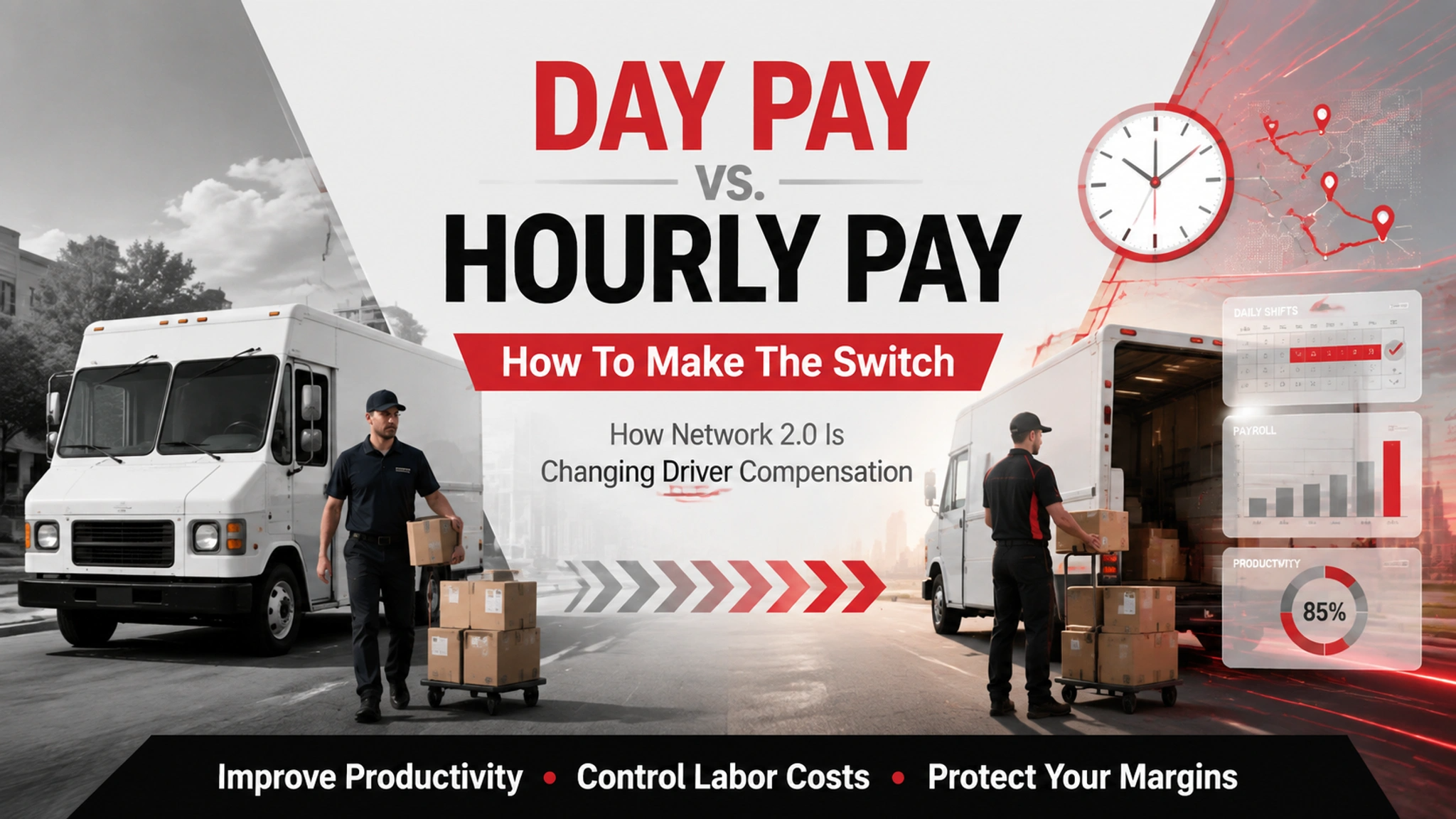
For two decades or more, the flat day-rate has been the default way most Service Providers contracted to FedEx paid P&D drivers. It was simple, it was predictable, and it fit the old operating model perfectly: here's your route, here's your $170, get it done and go home. Industry surveys still show the fixed daily wage as the most common pay structure among contractors, with typical rates running $135 to $180 per day.
Network 2.0 is breaking that model. FedEx has now implemented Network 2.0 at approximately 360 locations, has fully converted Canada, and expects to complete the U.S. rollout by the end of calendar year 2027. As stations consolidate and Express volume flows into your dispatches, the workday stops looking like an assembly line — one driver, one route, one predictable finish time — and starts looking like a job shop: variable volume, variable shift lengths, staggered waves, and days that stretch or compress based on what actually shows up on the belt. A pay system built for "just get it done" does not survive contact with a shift-based operation.
Read More
Topics:
FedEx,
Management,
Payroll,
Scheduling,
BC,
Driver,
Business Growth & Support System,
Administration,
Driver Pay,
Day-Pay,
Hourly Pay
More than 160 overtime lawsuits are currently working their way through federal courts in Massachusetts and Pennsylvania, all built on the same theory: that FedEx acts as a "joint employer" of ISP drivers and therefore owes them unpaid overtime under the Fair Labor Standards Act (National Law Journal). Law.com Radar flagged the filing surge in late February, and the number keeps climbing. For a lot of CSPs, that headline reads like someone else's problem — FedEx's name is on the complaint, not yours.
That read is backwards, and the court record proves it. In January 2026, a Massachusetts federal court dismissed the lead joint-employer cases outright, ruling that 183 drivers hadn't shown FedEx controlled hiring, firing, pay rates, or employment records — the core test for joint-employer status (LegalClarity). In May 2026, a Pennsylvania federal court went further, severing the claims of 14,296 drivers and ordering each one to re-file individually within 60 days — which is almost certainly the "deluge" of new filings the headlines are describing. FedEx is not losing this fight. It is winning it, one ruling at a time, largely because of how the ISP contracting model is structured.
Read More
Topics:
Payroll,
Profit,
Financial,
Driver Pay,
Hourly
Network 2.0 has changed the financial landscape for FedEx Contracted Service Providers in ways that many operators are still working through. The consolidation of Express and Ground into a single integrated network has brought higher stop densities on some routes, increased operational complexity, and in many markets, a renegotiation environment through the MESO program that has suppressed per-stop revenue relative to what experienced contractors once earned. Costs have not stood still — research from the National Transportation Institute indicates that industry-wide trucking operating costs rose roughly 24% between 2019 and 2025, driven by insurance, fuel, and labor market pressures.
Read More
Topics:
Management,
Payroll,
Network 2.0,
Margins,
Budget,
Driver Pay,
Bonuses,
Margin,
Owner's Benefit
Network 2.0 has fundamentally changed the economics of FedEx contracting. The consolidation of Express and Ground into a single network has added new dispatch complexity, expanded service area requirements, and tightened the operational tolerances under which your settlement is engineered. In that environment, every cost variable matters — and no cost variable carries more weight than driver compensation. It is your largest expense by a wide margin, and how you structure it determines whether your business survives volume cycles or gets destroyed by them.
Read More
Topics:
Business Results,
Payroll,
Contract,
Costs,
Network 2.0,
BC,
Business Growth & Support System,
BudgetIQ,
Dispatch,
Driver Pay