

The Business of Independent Service Provider Contracting

If Turnover Is the Problem, "Retention" Is the Reason

Posted by Jeff Walczak on 9/17/26, 2:25 PM

Driver turnover is climbing across the FedEx Service Provider base, and the timing could not be worse. Our eTruckBiz data shows Service Provider driver turnover running 30–40% annually, with roughly a third of new hires gone before they reach the 90-day mark. That is consistent with the broader sector — Bureau of Labor Statistics JOLTS data shows annual separation rates in transportation and warehousing regularly exceeding 40%. The difference for you is that a national statistic is an abstraction and your roster is not.

Two things are converging right now. First, Network 2.0. FedEx has implemented the new model at roughly 360 locations, has closed more than 200 stations with 475-plus targeted by the end of 2027, and expects 65% of eligible daily volume to run through optimized facilities by the time this peak season hits. Many contractors have not been integrated yet. For those who have, the integration itself — new start times, reworked CSAs, new operational demands, and in some cases, new leadership — has been generating turnover on its own. Change is a resignation trigger, and Network 2.0 is nothing but change.

Second, peak. The 2026 FedEx Ground peak settlement period runs Saturday, November 21 through Friday, January 1, 2027 — six settlement weeks carrying surge stop charges. That is roughly ten weeks from today. A driver you hire in October is not a peak driver; a new hire realistically takes three to five weeks to become productive, and DOT qualification and Qual Cert processing eat into that before they ever run a route solo. The drivers who will actually carry your peak are already on your roster. The only real question is how many of them will still be there on December 15.

Read More

Topics: FedEx, Management, Business, Investment, leadership, peak, Driver, pay, Business Growth & Support System, Driver Pay, Hourly Pay, Builder, Retention, PerformanceIQ

Will UPS Be Coming After Your Drivers?

Posted by Jeff Walczak on 8/25/26, 3:08 PM

The UPS National Master Agreement with the Teamsters expires July 31, 2028. That is roughly two years out, and it would be easy to file it under "deal with it later." That would be a mistake. The decisions that determine how 2028 plays out — who has drivers, who has trucks, who has capacity, who has a rate structure that can absorb a surge — get made in 2026 and 2027. By the time the picket signs come out, the winners and losers are already sorted.

ShipMatrix president Satish Jindel put a name to it, telling FreightWaves that August 2028 will unleash a "tsunami" across the parcel industry regardless of how UPS handles the negotiation. His math is blunt: a senior UPS Teamster driver runs about $49 per hour in wages and roughly $65 per hour fully loaded with benefits, against FedEx drivers at about $35 to $39 per hour and regional carriers using contract fleets or gig labor at $15 per hour or less. UPS agreed in 2023 to a five-year deal the union valued at $30 billion, taking average full-time driver pay and benefits from about $145,000 to roughly $170,000 by the end of the contract (CBS News). That structure is not survivable against $15-an-hour competition, and UPS knows it.

Read More

Topics: Business Planning, Business Outlook, FedEx, Management, Contract, Agreement, Co-employee, Costs, Amazon, Driver Pay, Risks, Driver Turnover, Day-Pay, Hourly Pay, UPS, Teamsters, Productivity

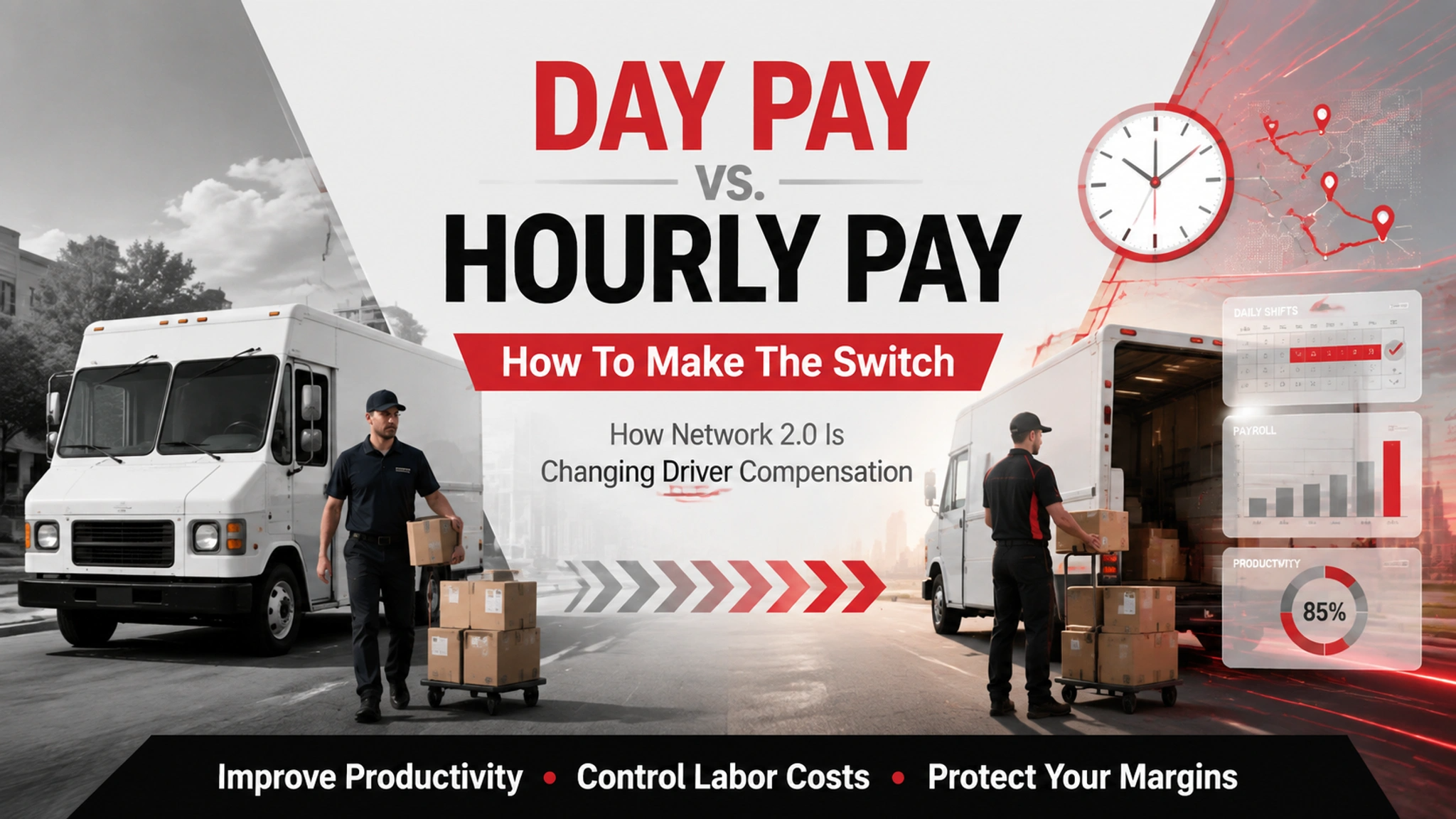
How to Convert Your Payroll From "Day-Pay" to Hourly: A Playbook SPs In Network 2.0

Posted by Jeff Walczak on 8/19/26, 3:34 PM

For two decades or more, the flat day-rate has been the default way most Service Providers contracted to FedEx paid P&D drivers. It was simple, it was predictable, and it fit the old operating model perfectly: here's your route, here's your $170, get it done and go home. Industry surveys still show the fixed daily wage as the most common pay structure among contractors, with typical rates running $135 to $180 per day.

Network 2.0 is breaking that model. FedEx has now implemented Network 2.0 at approximately 360 locations, has fully converted Canada, and expects to complete the U.S. rollout by the end of calendar year 2027. As stations consolidate and Express volume flows into your dispatches, the workday stops looking like an assembly line — one driver, one route, one predictable finish time — and starts looking like a job shop: variable volume, variable shift lengths, staggered waves, and days that stretch or compress based on what actually shows up on the belt. A pay system built for "just get it done" does not survive contact with a shift-based operation.

Read More

Topics: FedEx, Management, Payroll, Scheduling, BC, Driver, Business Growth & Support System, Administration, Driver Pay, Day-Pay, Hourly Pay

Independent Service Provider (ISP) Tips And Advice

Learn From Industry Experts And Successful Contractors

Get valuable, actionable information from our founder and other industry participants that also have a deep understanding of your business and want to help you maximize your opportunity. Keep up with all the issues that affect your business.

  • Stay Informed
  • Find and Implement Other Best Practices
  • Learn Profit Maximizing Strategies
  • Make Running Your Business Easy
  • Create More Time To Do The Things You Want To Do

Subscribe to Receive New Posts

Recent Posts

Posts by Topic

see all