
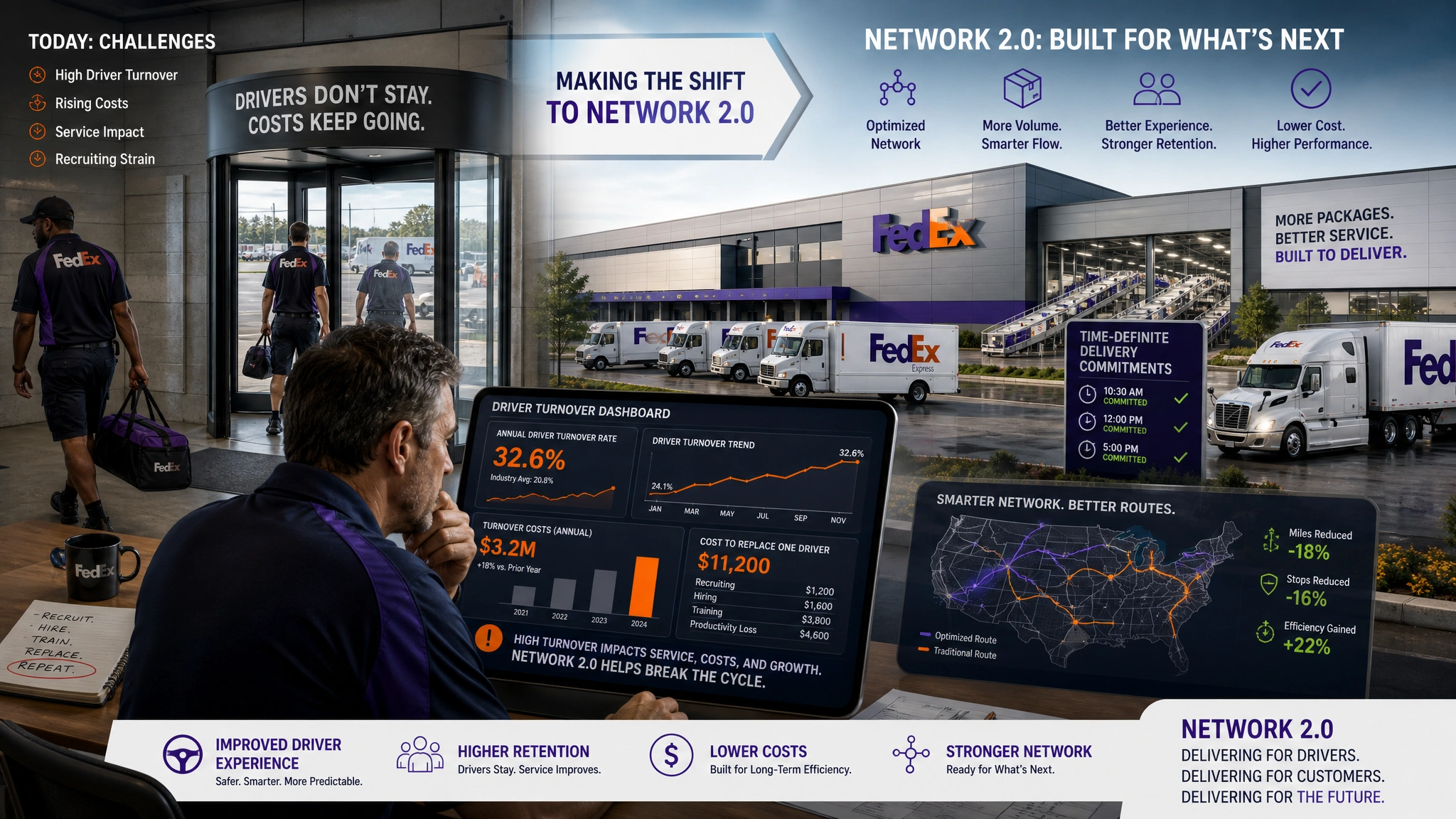
Network 2.0 has stopped being a future event. By the 2026 peak, FedEx expects roughly 65% of eligible daily volume to flow through optimized facilities, with nearly 400 sites already online and a target of closing more than 475 stations by the end of 2027.
For Contracted Service Providers, this is not an abstract corporate restructuring. It is a redrawn map of your service area, denser areas, integrated Express volume, and time-definite delivery standards that hold you to a 98.5% on-time commitment for first overnight, priority overnight, and 2Day AM packages.
As eTruckBiz has written before, Network 2.0 "changed the job description of every FedEx Contracted Service Provider".
Here is the part most contractors are not connecting: the single biggest threat to executing Network 2.0 successfully is sitting in your driver roster right now. We were recently reviewing turnover numbers across our client base and found something troubling. Some contractors were simply bringing on new drivers as fast as they could replace the ones walking out the door, with little or no thought given to why those drivers were leaving or how to keep them. The attitude had quietly hardened into a shrug: "Drivers just don't stay anymore."
That attitude is going to cost contractors real money in Network 2.0—both in direct replacement expense and in the service failures that come from running a route with a driver who does not yet know it. This post breaks down what turnover actually costs, why it happens, why it matters more under Network 2.0 than it ever did before, and the specific moves that reduce it.
Turnover Is a Culture Problem Before It's a Staffing Problem
Before we get to numbers, name the real issue. High driver turnover in the contractor world is rarely just a labor-market problem. It is a culture problem—part societal, part company. The societal part is real: across trucking, large truckload carriers run annualized turnover near 90%, and turnover at large fleets jumped 16 points to 90% in the most recent ATA quarterly report, the highest since 2015 A Fall 2025 driver survey found 56.3% of drivers actively looking for a new job, the highest in four years of tracking.
The labor market is genuinely churning.
But here is the uncomfortable truth: the societal part is the part you cannot control, and too many contractors hide behind it. They use "drivers just don't stay anymore" as permission to stop trying. The company part of the culture problem—the part you own—is where turnover is actually won or lost. The OOIDA research on driver churn makes this point bluntly: many carriers have come to "accept high turnover as a cost-minimizing response," treating constant churn as a rational business strategy rather than a failure to fix. When you stop asking why drivers leave, you have decided that turnover is the weather instead of a decision you are making every day.
High turnover is also a leadership signal. When a route revolves through three or four drivers a year, that is not always a "bad drivers" problem—it is frequently a "how are we leading these people" problem. The contractors who get this right treat retention as a management discipline, not a recruiting volume game.
What a Single Turnover Actually Costs You
Most contractors underestimate the cost of turnover because they only count the obvious line items—the ad spend, the orientation. The real number is far larger once you account for everything.
The most-cited academic estimate, from the Upper Great Plains Transportation Institute, puts the average cost to replace a driver at $8,234, with a range from $2,243 to $20,729 depending on the operation. More recent industry breakdowns land in a similar place: a fully loaded replacement cost of $8,000 to $15,000 once you include recruiting and advertising ($2,000–$5,000), screening and onboarding ($1,500–$3,000), training and orientation, lost revenue while the seat sits empty ($3,000–$7,000 over one to three weeks), and administrative costs .
In our experience working with FedEx CSPs, the realistic all-in cost for a service provider is likely $7,000 or more per turnover—and that is conservative once you factor in the Qual Cert training expense and the productivity drag of a driver still learning a route. Qual Cert training alone runs roughly $2,600 to $2,900 per provider engagement, and every new driver must complete it regardless of experience
Run the math at your own operation. A 15-truck contractor with 70% annual turnover replaces about 10 drivers a year. At a conservative $7,000 each, that is $70,000 walking out the door annually. Push that cost to a realistic $10,000 all-in and you are at $100,000—gone, every year, to a problem most contractors have decided is simply unavoidable. That is not a rounding error on a business where net margins often sit in the single digits. Dropping turnover from 70% to 40% on that same fleet recovers roughly $42,000 to $60,000 a year before you count a single gain in service quality or productivity.
Ask yourself: do you know your turnover rate to the percentage point? Do you know your fully loaded cost per replacement? If you cannot answer both, you are flying blind on one of your largest controllable expenses.
Why Turnover Hurts More Under Network 2.0
Even if the dollar cost of turnover stayed flat, Network 2.0 raises the stakes dramatically for one simple reason: the job got harder, and experience now matters more than it used to.
Time-Definites Punish Inexperience
Under Network 2.0, integrated Express volume brings time-definite deliveries with hard commit windows and a 98.5% on-time service standard. A driver who has run a route for eighteen months knows the shortcuts, the tricky receiving docks, the customers who need a call, and how to sequence the morning so the first-overnight commitments land on time. A driver who started three weeks ago does not. When you churn drivers constantly, you are perpetually staffing your most time-sensitive deliveries with your least-prepared people. That is how a contractor with a "service problem" discovers the service problem was actually a turnover problem.
Density Rewards Drivers Who Know the Route
Network 2.0 is adding roughly 20% more density to many service areas, which raises the profitability ceiling but also demands more productivity per driver. The longer a driver stays, the more productive they become—they shave minutes off every stop, handle more packages per hour, and absorb dynamic routing without melting down. That productivity curve is real money. A tenured driver completing a denser route inside the planned day protects your dispatch yield; a rookie who runs long burns overtime and risks the time-definite miss. Network 2.0 has effectively turned driver tenure into a financial asset.
This is the core argument: in the old network, you could survive sloppy retention because routes were static and forgiving. In Network 2.0, with dynamic routing, denser stops, and time-definite penalties, experienced drivers are no longer a nice-to-have—they are the difference between a profitable optimized contract and a service-failure spiral.
What Actually Causes Drivers to Leave
The research is remarkably consistent on why drivers quit, and almost none of the top reasons are "the pay wasn't high enough on day one." Pay and advertising bring applicants in the door; they do not keep anyone around.
The leading causes across recent surveys are time off and predictability, pay disputes and payroll errors, poor communication from management, weak or disorganized onboarding, physical demands without acknowledgment, and a lack of advancement.
One UK last-mile analysis found that automating accurate, on-time pay alone produced a 47% improvement in retention—drivers leave when they cannot trust that the basics will be handled right.
The timing matters too. Across warehouse and last-mile operations, roughly 35% of new hires quit within the first 90 days and nearly 40% of all turnover happens in that window. That means a large share of your turnover cost is being spent on people who never become productive at all. You pay to recruit and train them, then they leave before they have earned their way past the cost. Fix the first 90 days and you fix most of your turnover problem.
Putting It Together: 7 Tips for Reducing Turnover in Network 2.0
- Decide that turnover is a choice, not the weather. Reducing turnover starts with leadership rejecting the "drivers just don't stay anymore" mindset. Set a target turnover rate, measure against it monthly, and treat every departure as a question worth answering rather than a seat to refill.
- Hire to retain, not just to fill. Reducing turnover starts at recruiting. Screen for fit with your operation and your routes, set honest expectations about Network 2.0 dynamic routing up front, and stop hiring anyone with a pulse just to cover a gap—that is how you guarantee a 90-day quit.
- Win the first 90 days. With 35% of departures happening in the first quarter, structured onboarding is your highest-ROI retention move. Build a 90-day plan, pair new drivers with a mentor, and run deliberate 30/60/90-day check-ins. Get Qual Cert done cleanly and get them confident on the route fast.
- Lead people—don't just dispatch them. Drivers want feedback and want to feel part of something. Communicate openly about what is happening with the company and with FedEx Network 2.0 changes, because uncertainty drives people out. People who understand the mission stay; people kept in the dark leave.
- Make appreciation visible and non-monetary. Pay attracts; recognition retains. Build simple programs that cost little: Driver of the Week, a Driver Hall of Fame, a 100% Service Club for perfect on-time records. Public, specific recognition ("Thanks, John, for handling that downtown commit on time all week") does more than a generic bonus.
- Build a ladder. Offer advancement: lead-driver roles, senior-driver status with real perks, mentor or trainer positions. A driver who sees a path forward in your business has a reason to stay through the hard parts of Network 2.0. A driver who sees a dead-end seat does not.
- Fix the basics that quietly bleed drivers. Accurate, on-time pay every single time. Well-maintained vehicles. Fair, consistent workload across drivers. These are not glamorous, but payroll errors and unreliable equipment are top departure triggers—and they are entirely within your control.
Network 2.0 is rewarding precision operators and punishing the ones who treat their business as a churn machine. Volume and density alone will not create profit—experienced, well-led drivers running those denser routes on time are what convert Network 2.0's promise into margin. Contractors who decide, starting now, that turnover is a number they manage rather than a fate they accept will be the ones standing strong when consolidation finishes in 2027. eTruckBiz Inc. works with FedEx Contracted Service Providers to turn operational discipline into measurable profit—and reducing driver turnover is one of the clearest, fastest paths to it. If you'd like to look at your turnover numbers and build a retention plan that fits your operation, reach out to our team. That is what we mean by The Right Service Provider Support, Right Now.