The UPS National Master Agreement with the Teamsters expires July 31, 2028. That is roughly two years out, and it would be easy to file it under "deal with it later." That would be a mistake. The decisions that determine how 2028 plays out — who has drivers, who has trucks, who has capacity, who has a rate structure that can absorb a surge — get made in 2026 and 2027. By the time the picket signs come out, the winners and losers are already sorted.
ShipMatrix president Satish Jindel put a name to it, telling FreightWaves that August 2028 will unleash a "tsunami" across the parcel industry regardless of how UPS handles the negotiation. His math is blunt: a senior UPS Teamster driver runs about $49 per hour in wages and roughly $65 per hour fully loaded with benefits, against FedEx drivers at about $35 to $39 per hour and regional carriers using contract fleets or gig labor at $15 per hour or less. UPS agreed in 2023 to a five-year deal the union valued at $30 billion, taking average full-time driver pay and benefits from about $145,000 to roughly $170,000 by the end of the contract (CBS News). That structure is not survivable against $15-an-hour competition, and UPS knows it.
Read More
Topics:
Business Planning,
Business Outlook,
FedEx,
Management,
Contract,
Agreement,
Co-employee,
Costs,
Amazon,
Driver Pay,
Risks,
Driver Turnover,
Day-Pay,
Hourly Pay,
UPS,
Teamsters,
Productivity
For two decades or more, the flat day-rate has been the default way most Service Providers contracted to FedEx paid P&D drivers. It was simple, it was predictable, and it fit the old operating model perfectly: here's your route, here's your $170, get it done and go home. Industry surveys still show the fixed daily wage as the most common pay structure among contractors, with typical rates running $135 to $180 per day.
Network 2.0 is breaking that model. FedEx has now implemented Network 2.0 at approximately 360 locations, has fully converted Canada, and expects to complete the U.S. rollout by the end of calendar year 2027. As stations consolidate and Express volume flows into your dispatches, the workday stops looking like an assembly line — one driver, one route, one predictable finish time — and starts looking like a job shop: variable volume, variable shift lengths, staggered waves, and days that stretch or compress based on what actually shows up on the belt. A pay system built for "just get it done" does not survive contact with a shift-based operation.
Read More
Topics:
FedEx,
Management,
Payroll,
Scheduling,
BC,
Driver,
Business Growth & Support System,
Administration,
Driver Pay,
Day-Pay,
Hourly Pay
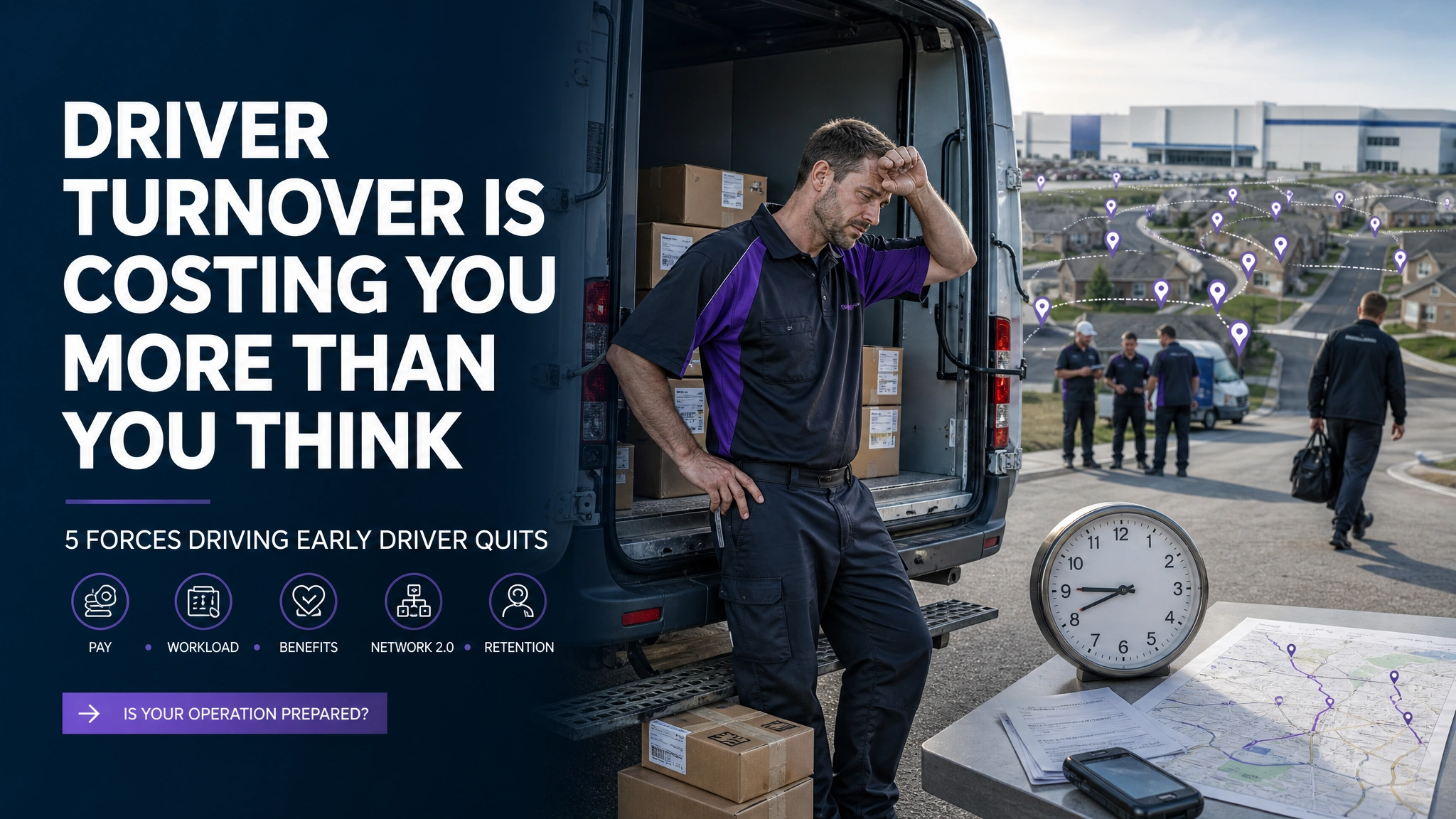
Our eTruckBiz data shows Service Provider driver turnover is running 30–40% annually, and roughly a third of new hires are gone before they hit the 90-day mark. That number was already ugly before Network 2.0 accelerated route restructuring, station consolidation, and volume shifts across the network — FedEx has already closed more than 200 stations, with 475+ facilities targeted for closure by the end of 2027, and 65% of eligible daily volume expected to run through optimized Network 2.0 facilities by the 2026 peak season. When a facility absorbs the volume of three surrounding stations overnight, CSAs often get reconfigured and daily stop counts can jump 15–20% with little warning — and that volatility lands hardest on the newest, least-prepared drivers on your roster.
Read More
Topics:
FedEx,
Management,
leadership,
Network 2.0,
driver management,
AdminIQ,
Turnover,
Team Building,
Business Growth & Support System,
Driver Turnover
The FedEx Service Provider space remains one of the best opportunities in American small business to own a contracted, revenue-backed operation with a Fortune 50 customer. That has not changed. What has changed is the environment around it. FedEx has already closed more than 200 stations and optimized over 360 facilities under Network 2.0, with roughly 475 locations — about 30% of its footprint — targeted by the end of 2027, and the company expects 65% of eligible daily volume to flow through optimized facilities by the 2026 peak season. Add the FedEx Freight spinoff completed June 1, 2026, and you have a contracting environment that rewards operators who understand exactly what they signed up for — and could punish the ones who don't.
Read More
Topics:
Compliance,
FedEx,
Management,
Business,
Investment,
Purchase,
Regulation,
brokerage,
CSA,
Impacts,
Turnover,
Contracting,
Systems,
Risks
One of the first things a new Pickup & Delivery (P&D) Service Provider contracted to FedEx discovers is that running a profitable P&D operation requires a financial model unlike almost any other business. And one of the first challenges they discover? Nobody hands them one.
Figuring out where to even begin building a financial framework for a FedEx P&D operation is genuinely complicated. The revenue structure is unique to the P&D model. The cost drivers are specific to how P&D routes are structured, staffed, and dispatched. And constructing an accurate financial model on your own — through research, trial, and adjustment — can be extraordinarily expensive. Some P&D operators spend years and hundreds of thousands of dollars piecing it together. Others never quite get there.
Read More
Topics:
Business Tools,
FedEx,
model,
Cash flow,
Costs,
Financial,
Network 2.0,
Budget,
service provider,
BudgetIQ,
new,
opportunity
A successful Network 2.0 integration does not just happen. The Service Providers who come through it leaner and more profitable get there because of the thought and planning they put in before the changes were ever implemented. eTruckBiz has now helped guide hundreds of Service Providers through a successful integration — shaping their operations both before and after the new model lands. The pressure behind this is real and accelerating: FedEx has already closed more than 200 stations and optimized over 360 facilities, with plans to close roughly 475 locations — about 30% of its footprint — by the end of 2027. By the 2026 peak season, FedEx expects 65% of eligible daily volume to flow through optimized Network 2.0 facilities The consolidation is not coming. For a growing share of contractors, it is already here.
Read More
Topics:
Business Planning,
Driver Recruiting,
Business Results,
FedEx,
Cash flow,
Costs,
Network 2.0,
time definite,
AdminIQ,
Logistics,
Business Growth & Support System,
Dispatch
Network 2.0 changed the job description of every FedEx Contracted Service Provider. What used to be a business that rewarded volume and operational consistency has become a business that punishes inattention. Time-definite commitments, consolidated Express and Ground dispatches, new CSA structures, and tightening performance standards mean that the window for error — and for distraction — has never been smaller. Every hour your attention is buried in payroll entries, compliance paperwork, driver screening, or administrative follow-ups is an hour that should have been spent on the field-level / truck-level work that actually determines whether your operation succeeds or fails.
That is not a philosophical point. It is a financial one. If your service metrics suffer because your BC was on the phone chasing a vendor issue instead of monitoring time-definite commit windows, the cost is measured in decreased productivity, missed TD service , and — eventually — your standing with FedEx. If your drivers are running suboptimal routes because no one had time to review and engineer them properly, you are burning fuel, driver hours, and stop productivity every single dispatch. The administrative burden that feels like a nuisance is actually a slow leak on your profitability, and in the Network 2.0 environment, slow leaks become fast ones.
This is precisely why eTruckBiz built AdminIQ into the Business Growth and Support System. AdminIQ handles the non-revenue-producing administrative work so that you and your management team don't have to. But the value of AdminIQ is not just what it does — it is what it frees you to do instead. This post identifies the seven highest-value activities that contractors who recapture their time should be executing, and explains why each one has a direct and measurable impact on profitability in the new FedEx operating environment.
Read More
Topics:
Business Planning,
FedEx,
Payroll,
ISP,
Investment,
Costs,
Network 2.0,
BOSS,
CSA,
BC,
Driver,
AdminIQ,
Business Growth & Support System,
Administration,
3rd Party Support
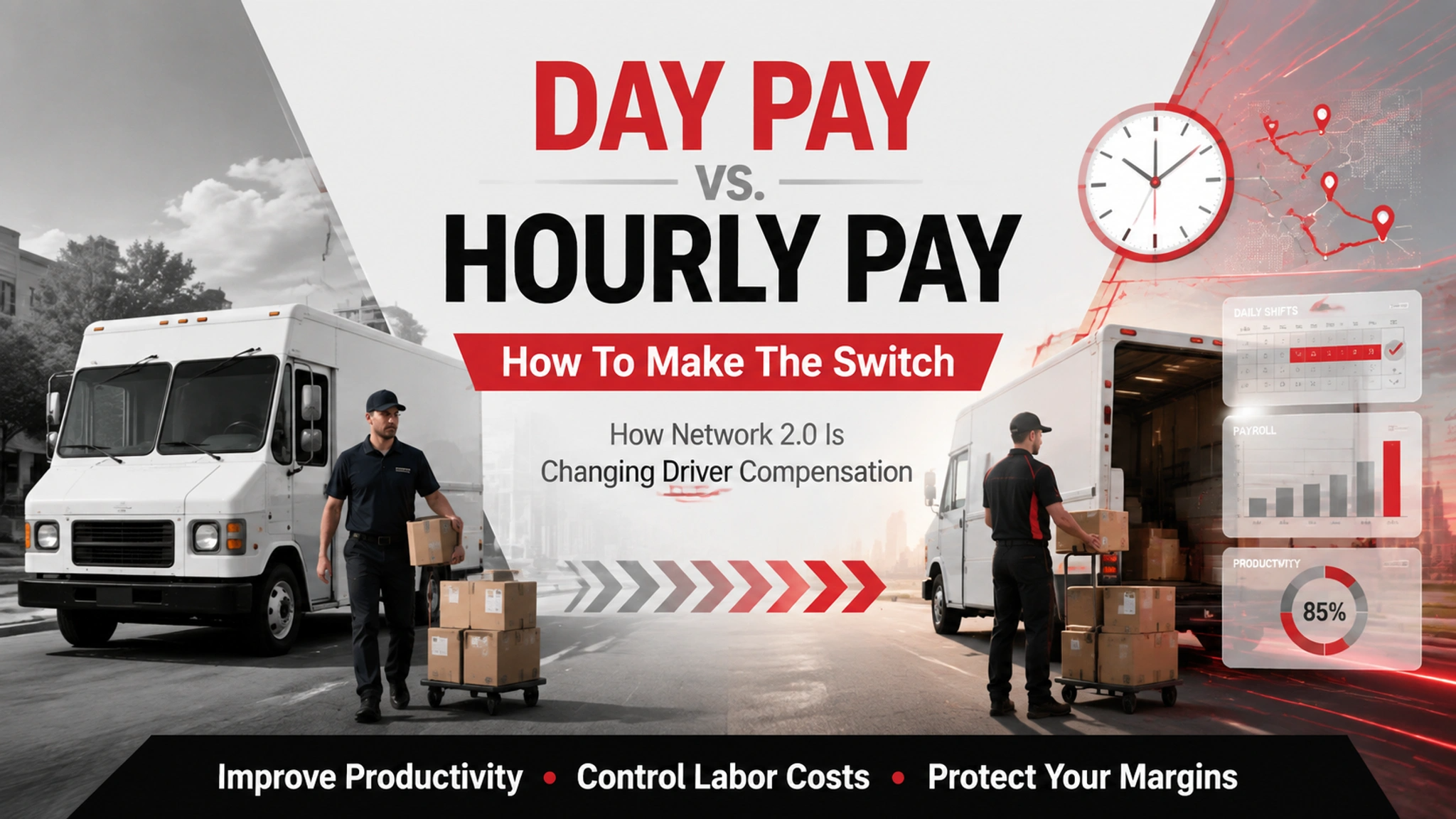
As FedEx contractors continue adapting to Network 2.0, many are realizing that the traditional day-pay model no longer aligns with the realities of today’s operation. Between changing dispatch times, increased time commitments, rising labor costs, and driver retention challenges, contractors are being forced to rethink how they manage both productivity and payroll. In a recent discussion with experienced CSPs who successfully transitioned from day pay to hourly pay, several key lessons emerged around labor control, operational efficiency, driver accountability, and long-term business stability. Their experiences offer valuable insight for contractors looking to improve profitability while building a more scalable and sustainable operation.
Read More
Topics:
FedEx,
Management,
Business,
overtime,
contractor,
pay,
Business Growth & Support System,
Day,
Hourly,
Operation
Last week's Business Update established a foundational truth about Network 2.0: paying your drivers by the hour is the margin-protective move. Paying by the day — the model most Ground-only contractors grew up with — guarantees your driver a fixed income regardless of how long the route actually takes or how efficiently the work gets done. In a world where you are now running both Express time-definite stops and Ground volume on the same routes, that guaranteed-pay structure bleeds money every time a driver takes longer than planned.
But knowing that hourly pay is the right structure is only half the problem solved. The harder half is this: actually running an hourly operation is fundamentally different from running a daily one. The habits, the oversight cadence, the role of your Business Contact, the way you think about equipment, the way you handle afternoons — nearly all of it changes. Contractors who switch to hourly pay without changing how they manage will not capture the margin benefit. They will simply have a new pay structure layered on top of an old operational approach, and the numbers will not improve the way they should.
This post walks through what managing by the hour actually requires — the shifts in thinking, the systems you need, and the specific areas where most contractors leave money on the table during the transition. If you made the move to hourly or are about to, this is the operational framework you need to back it up.
Read More
Topics:
FedEx,
Management,
Business,
overtime,
contractor,
pay,
Business Growth & Support System,
Day,
Hourly,
Operation
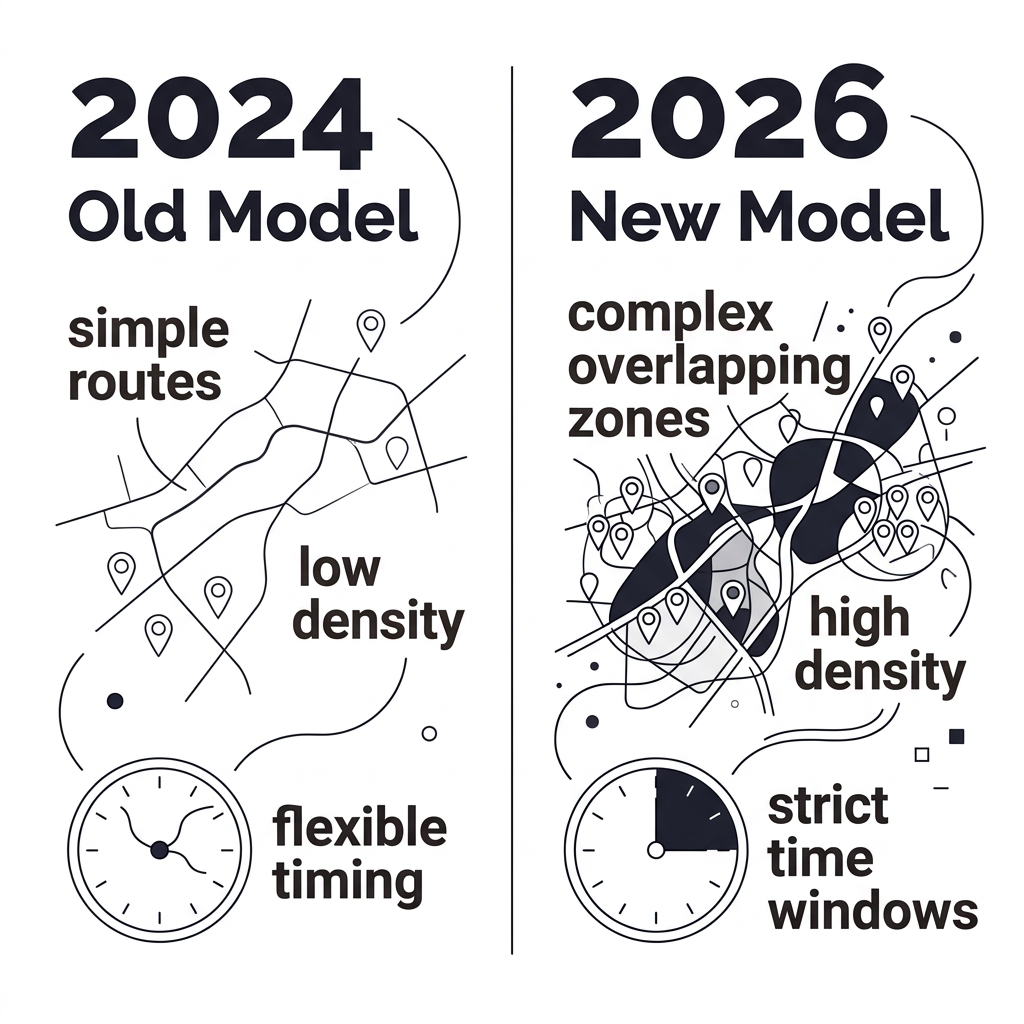
The rules of profitability in FedEx's pickup and delivery world have always been demanding. In the Network 2.0 environment — FedEx's multi-year initiative to consolidate its Express and Ground networks into a single, unified system — those rules are becoming even less forgiving. With 200 station closures and 290 facility conversions completed by mid-2025, and with full integration expected around 2027, contractors are operating in a landscape defined by higher volume expectations, compressed timelines, and redefined performance metrics.
In this environment, dispatch strategy is not just an operational decision. It is a financial one. Every truck you roll out the door, every route you create, every shift you schedule either builds your profitability or erodes it. The margin between a sustainable operation and a money-losing one often comes down to choices made before 8 a.m. every morning.
Read More
Topics:
Business Planning,
FedEx,
Business,
Profit,
Costs,
Network 2.0,
Margins,
Express,
CSA,
efficiency,
Utilization,
service provider,
Route Optimization,
Dispatch
The consolidation is no longer coming. It's here.
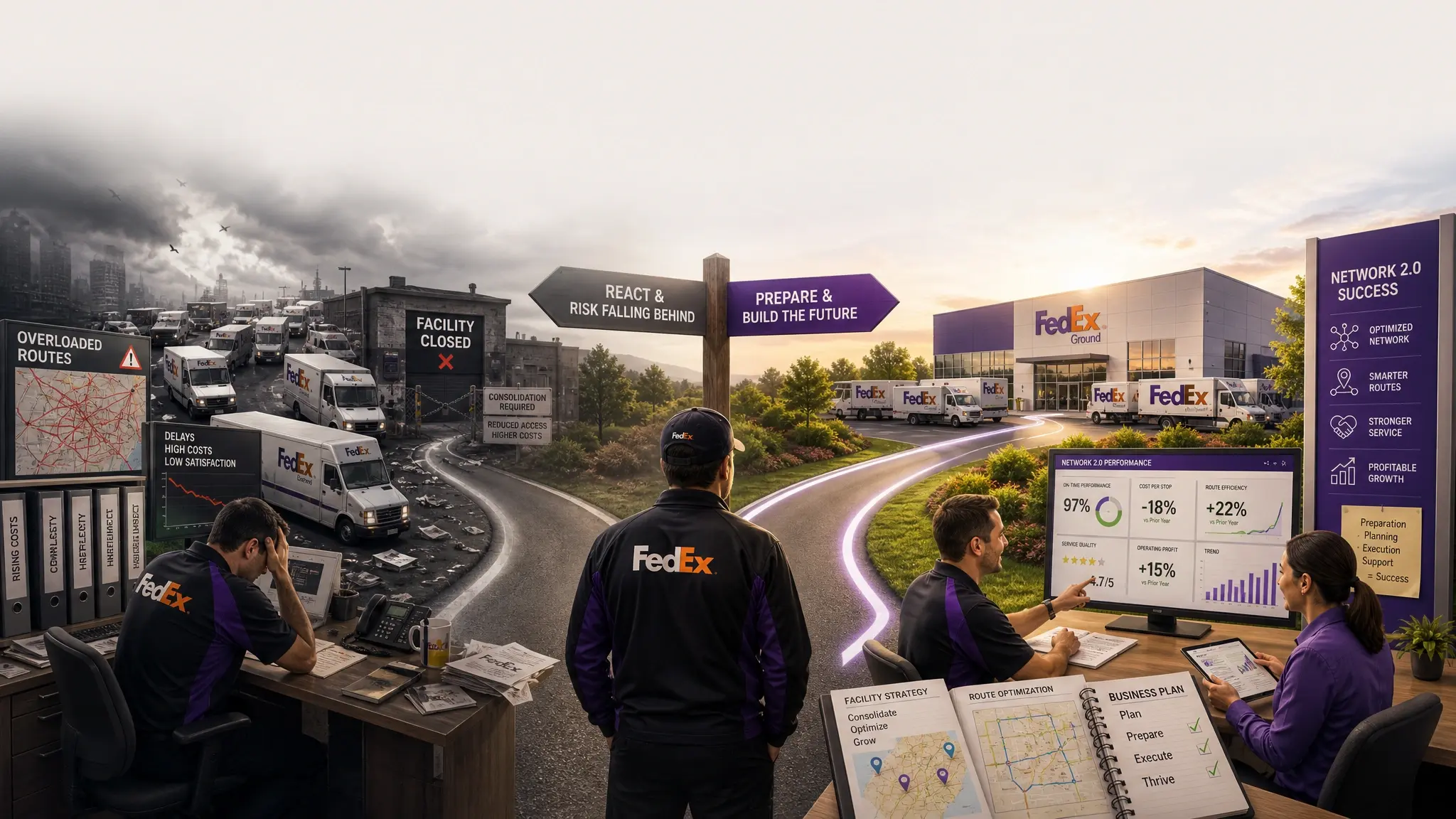
FedEx has already shuttered more than 200 stations as part of Network 2.0, with plans to close 475+ facilities by end of 2027. By the time the 2026 peak season hits, 65% of eligible daily volume will run through optimized Network 2.0 facilities. If you're a FedEx Ground contractor still running business as usual — same routes, same cost structure, same staffing model — you may already be behind the curve. The question isn't whether Network 2.0 will affect your business. The question is whether your business is built to survive — and thrive — inside it.
Let's talk about how to find out.
Read More
Topics:
Business Outlook,
FedEx,
Business,
Contract,
Negotiation,
Network 2.0,
Express,
CSA,
Market,
Volume,
Business Growth & Support System
It happens when you least expect it. Your phone rings early in the morning, and one of your key drivers tells you they are quitting. Suddenly, you have a full route sitting on the floor, and panic sets in.
You scramble to post a job ad, hoping to find a qualified candidate before your service levels plummet. You ask your remaining team to pick up the slack, pushing them to their limits. You rush through interviews, desperate to put a warm body in the driver's seat.
This is the chaotic reality of reactive recruiting. When you only look for drivers after a role opens up, you place immense pressure on your entire operation. Consistent recruiting, on the other hand, transforms hiring from an intense, short-lived crisis into a low-impact, long-term strategy.
In fact, the most basic of basic keys to running a stable FedEx-based transportation operation is to always have driver candidates at the ready.
Here is how shifting your mindset to "always be recruiting" can save your business, protect your team, and improve your bottom line.
Read More
Topics:
Driver Recruiting,
FedEx,
Management,
Network 2.0,
Fleet Management,
Team Building
Not long ago, I sat down for dinner, in Columbus, Georgia, with two FedEx contractors — one brand new and one who’s been doing this for what feels like forever. Honestly, I didn’t expect the conversation that unfolded to hit me as hard as it did. I’ve been thinking a lot about it since then because I’m afraid that way too many “veteran” contractors have been conditioned to think much like the one I’m about to tell you about.
We were at this little place with the best shrimp and grits I’ve had in a long time. As it always does, the conversation turned to “not making any money”. As it did, I mentioned that several of our clients are running operations with 10% — even 12% or better — operating margins. Before I could take another bite, the longtime contractor quickly dropped his fork, leaned back, and basically said, “No way. That’s impossible.”
He wasn’t joking. He was genuinely angry — not at me, but at the thought that someone out there could make money doing the same thing he does every day. He was "visibly pissed”.
Read More
Topics:
Business Results,
FedEx,
Bookeeping,
Business,
Investment,
Profit,
Money,
Cash flow,
Costs,
Financial,
Network 2.0,
Margins,
Contracting,
BudgetIQ
We’d like to make something crystal clear to begin with: FedEx wants you to succeed. We know it doesn’t always feel that way. When you're dealing with terminal audits or mounting pressure, it can feel like the "Eye of Sauron" is fixed squarely on your business. But the reality is that FedEx needs you. They rely on Contracted Service Providers (CSPs) to move every package they sell. It is significantly more expensive and logistically painful for FedEx to intervene and manage "open work areas" than it is to support a healthy, compliant contractor.
Ultimately, your success protects the brand. However, there are lines that, once crossed, make termination or non-renewal a business necessity for FedEx.
While definitely not an exhaustive list, here are 12 critical pitfalls (with eTruckBiz solutions) to avoid to keep your contract secure.
Read More
Topics:
FedEx,
ISP,
Contract,
Investment,
Agreement,
Open CSA,
Termination,
Renewal
Most entrepreneurs spend the first several years of their journey in a desperate, uphill battle. They are consumed by the "Big Three" of traditional business: Marketing (finding customers), Sales (convincing customers to buy), and Inventory/Supply Chain (managing the physical goods). It is an exhausting, capital-intensive process where failure to master just one of these pillars usually means the end of the venture.
FedEx Service Providers (ISPs) enter a completely different world. In this space, the heavy lifting of traditional business growth is effectively "pre-solved." FedEx provides the global brand recognition, the consistent flow of customers (revenue) , the pricing structures, and the daily volume. You don’t need a marketing department to generate leads, and you don’t need a sales team to close deals. The packages are already at the terminal, waiting for you.
On the surface, it looks like the ultimate "turnkey" business.
Read More
Topics:
Business Structure,
Business Planning,
FedEx,
Investment,
model,
Network 2.0,
Contracting,
Business Growth & Support System,
Administration,
BudgetIQ,
Route Optimization