---
title: "The Network 2.0 Integration Checklist: What Every FedEx SP Should Do Before the Timeline Hits"
description: "A Network 2.0 integration checklist for FedEx CSPs: 10 steps to protect margin, shift to hourly dispatch, and prepare your operation before the timeline hits."
image: https://info.etruckbizforfxg.com/hubfs/1_output_1781790810052322_QDUzJryiy.webp
---
- 855-873-8585
- [Facebook](https://www.facebook.com/pages/ETruckBiz/154560897943915?ref=hl)
- [Twitter](https://twitter.com/eTruckBiz)
- [Mail](mailto:clientcare@etruckbiz.com)
[](http://www.etruckbizforfxg.com/)
# The Business of Independent Service Provider Contracting
## [The Network 2.0 Integration Checklist: What Every FedEx SP Should Do Before the Timeline Hits](https://info.etruckbizforfxg.com/blog/the-network-2.0-integration-checklist-what-every-fedex-sp-should-do-before-the-timeline-hits)
Posted by [Jeff Walczak](https://info.etruckbizforfxg.com/blog/author/jeff-walczak) on 6/18/26, 10:11 AM
- [Tweet](https://twitter.com/share)
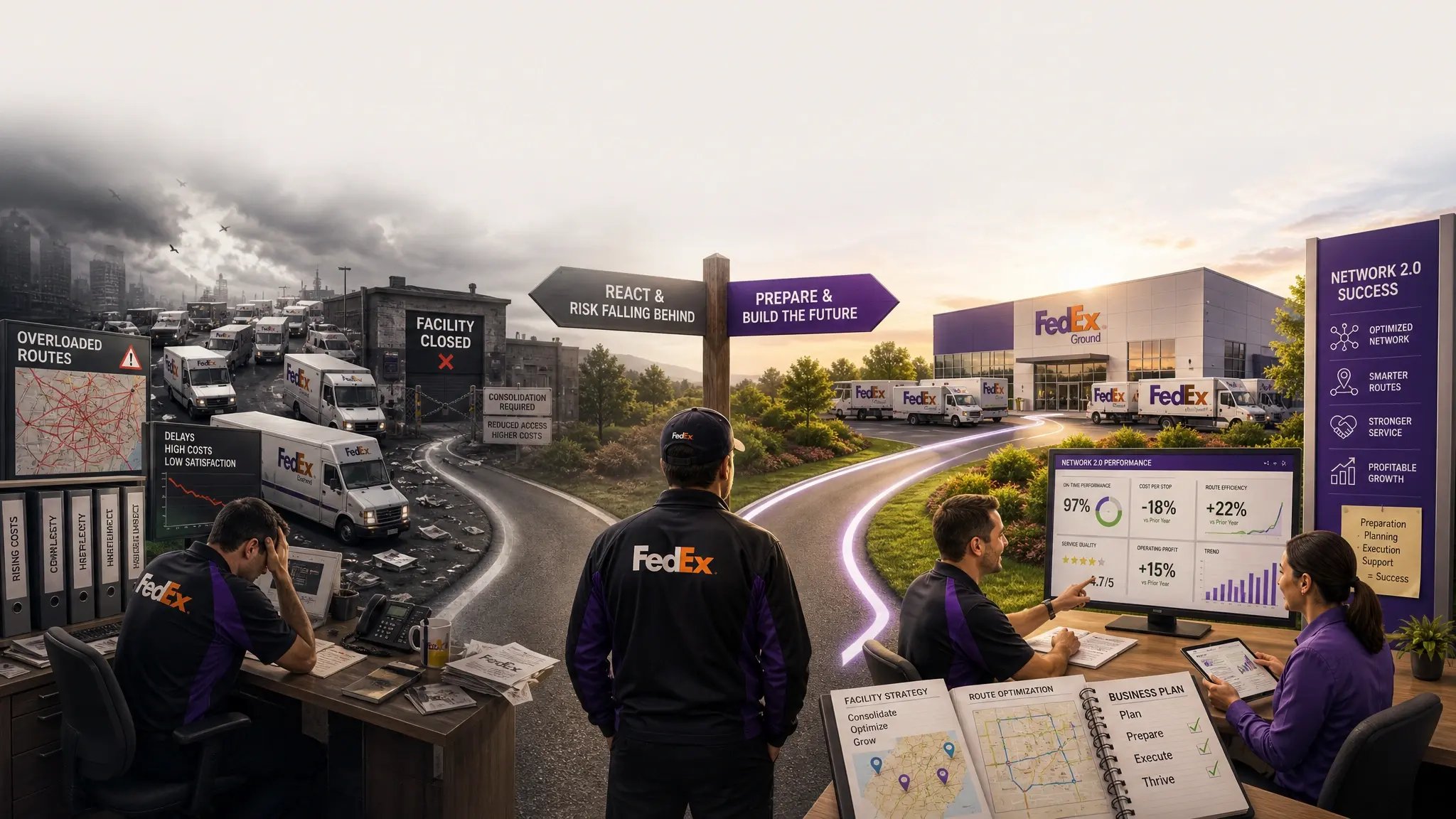A successful Network 2.0 integration does not just happen. The Service Providers who come through it leaner and more profitable get there because of the thought and planning they put in before the changes were ever implemented. eTruckBiz has now helped guide hundreds of Service Providers through a successful integration — shaping their operations both before and after the new model lands. The pressure behind this is real and accelerating: FedEx has already closed more than 200 stations and optimized over 360 facilities, with plans to close roughly 475 locations — about 30% of its footprint — by the end of 2027. By the 2026 peak season, FedEx expects 65% of eligible daily volume to flow through optimized Network 2.0 facilities The consolidation is not coming. For a growing share of contractors, it is already here.
The hard truth most contractors learn too late is that integration does not give you a long runway. When your station optimizes, the new operating model lands fast — combined Express and Ground volume on the same dispatches, time-definite commitments embedded directly in the contract, and a settlement engineered around assumptions you may have never measured. The contractors who struggle are not the ones who lacked talent. They are the ones who waited for the [integration](https://info.etruckbizforfxg.com/blog/unveiling-the-impact-of-network-2.0-integration-decisions-on-your-companys-future?hs_preview=PZLxWInR-161003100983) date to start changing, and then tried to rebuild the airplane while it was already in the air.
This post is a practical, sequenced checklist. It walks through what to do and — just as importantly — when to do it, working backward from your anticipated integration date. Treat it as a countdown. Some of these steps should already be in place. Others have a clear deadline tied to how close you are to optimization. Print it, mark your dates, and use it to drive the next several months of decisions in your business.
## **Why Integration Is a Financial Event, Not Just an Operational One**
It is tempting to think of [Network 2.0](https://www.freightwaves.com/news/fedex-network-restructure-boosts-agility-amid-shifting-trade-landscape) as an operations problem — new routes, new windows, new services. It is not. It is a financial event that happens to show up wearing an operations costume. Every truck you roll out the door, every shift you schedule, and every minute a driver spends on the road either builds your profitability or erodes it. Network 2.0 has tightened the operational tolerances under which your settlement is engineered, which means the margin for sloppiness has narrowed at exactly the moment complexity has increased.
Here is the concept that underpins everything else in this checklist: your revenue is engineered around productivity assumptions you did not set. FedEx builds your settlement assuming a stops-per-hour rate and a defined number of on-road hours — commonly in the range of roughly 14 stops per hour across about 8.33 on-road hours, though your specific numbers vary by contract and market.
If your drivers run below the engineered rate, you are [losing money](https://info.etruckbizforfxg.com/blog/stop-giving-your-money-away?hs_preview=HYyEydfT-209749719860)on volume the model already assumed you would handle efficiently. Layer in the 98.5% time-definite service standard now embedded in the contract — with no supplemental fee for hitting it, because it is simply expected — and you have an environment where being slow is no longer a service problem. It is a margin problem.
That is why this checklist is organized around financial readiness, not just operational mechanics. Each step below moves you closer to running a business where you know your numbers, manage by the hour, and make tactical decisions during the day based on cost — not on the old reflex of "just get it done."
## **The Checklist, Step by Step**
## **Step 1 — Accept That the Fundamentals Are Changing (When: as soon as your integration timeline is conveyed)**
The first move is mental, and it is the one most contractors skip. The fundamentals your business runs on today — [day pay](https://info.etruckbizforfxg.com/blog/day-pay-is-costing-you-more-than-you-think-driver-compensation-in-the-fedex-network-2.0-era?hs_preview=MkanOdty-212109738590), "come in when you want," finish-as-fast-as-you-can — are about to change. Some call it a pivot. Call it whatever h0elps you act on it. The contractors who accept this early give themselves months of preparation. The ones who treat the announcement as a rumor give themselves a crisis. Acceptance is not resignation; it is the precondition for everything that follows on this list.
## **Step 2 — Shift Driver Culture from a Daily Mindset to an Hourly Mindset (When: as soon as you have truly accepted the change)**
Under the old model, the goal was simple: get done. Under Network 2.0, the goal is to maintain a productive rate of work while hitting time-definite windows. Things now need to happen at specific times. A 10:30 commercial commit is not a stop you get to when you get to it — it is a contractual obligation with a service standard attached. Your drivers need to stop thinking about "their route" as a fixed list to clear and start thinking in terms of shift hours: what gets planned and executed during each hour of the shift. This is the [cultural foundation](https://info.etruckbizforfxg.com/blog/navigating-culture-change-a-roadmap-for-csp-success?hs_preview=PNGWYgSE-156881755263) that makes every later step possible. You cannot bolt hourly pay onto a daily mindset and expect the numbers to improve.
## **Step 3 — Assess Staffing and Recruit Aggressively (When: at least 3 months before integration)**
Network 2.0 will expose which of your people can adapt and which cannot. Ask the honest questions: Does the team have the ability to operate to [time-definite](https://info.etruckbizforfxg.com/blog/understanding-fedexs-time-definite-settlement-changes?hs_preview=lAiDIcCA-188176583235) standards? Will your most set-in-their-ways veterans let you change how the operation runs, or quietly resist it? You need a bench before integration, not after, because the worst time to recruit is when you are already short-staffed and a window is being missed. Aggressive, continuous recruiting is the only insurance against a key driver walking out the week your station optimizes. This is exactly the kind of always-on recruiting that **AdminIQ** is built to run for you, so the pipeline never goes dry.
## **Step 4 — Treat the Network 2.0 Contract Negotiation as the Foundation of Your Financial Future (When: as soon as new negotiations are announced — 4 to 6 months before integration)**
The Network 2.0 negotiations are different, and they are the foundation of an evolution in how you plan and execute your business finances. This is not just a conversation about rates — it is about the structure your revenue will run on for years, in an environment of higher volume expectations, compressed timelines, and redefined performance metrics.
Going into this conversation underprepared is one of the most expensive mistakes a contractor can make, because the terms you accept now set your ceiling. This is where the **eTruckBiz contract negotiation team**, supported by **BudgetIQ** and **BOSS**, helps you walk in with a defensible financial model instead of a hopeful guess.
## **Step 5 — Move to a "Shift Start Time" Operating Model (When: 2 months before integration)**
Replace the day-pay, salary-style "come in when you want" culture with a defined Shift Start Time. This is not a small [administrative](https://info.etruckbizforfxg.com/blog/why-the-contractors-who-thrive-in-network-2.0-will-run-multiple-facilities?hs_preview=xmfRfhmR-213581893774) tweak — it is the operational basis for punching in and out, which is the basis for paying by the hour. A defined shift has a start time, a planned dispatch window, and an expected end time. For example, if you want 8.33 on-road hours, you might schedule a 9-hour shift to allow for the pre-trip, fuel, and the post-trip inspection and paperwork Getting time-punch discipline in place two months out gives you real data before the model goes live.
## **Step 6 — Establish New FRO / Engineering Procedures (When: 1 to 2 months before integration)**
Your [route engineering](https://info.etruckbizforfxg.com/blog/optixappupdate?hs_preview=UaFCBNQn-184982220567)has to evolve to match the new environment. Use dynamic anchors instead of static ones, and engineer your routes around time-definite commitments rather than just stop counts. A route with three 10:30 commercial commits has constraints a residential-only route never had — and engineering that ignores those constraints produces dispatches that miss windows or burn labor. **PerformanceIQ** exists to bring this kind of engineering discipline into the daily operation so your plan reflects reality, not last year's assumptions.
## **Step 7 — Know Your Operational Costs by the Unit (When: should already be in place — if not, immediately)**
This is the step that should already be done, and for most contractors it is the biggest gap. You cannot make tactical decisions during the day if you do not know what a stop, a mile, and an hour actually cost you. Knowing cost by the unit is the only way your dispatcher can make real-time decisions about whether to add a truck, hold volume, or extend a shift — because every one of those choices has a price. Run the effective hourly rate calculation on every driver: total pay for the period (including bonuses) divided by total on-duty hours. A driver you think costs $20 an hour may actually cost $22.85 once you do the math
**BudgetIQ** and **PerformanceIQ** sharpen the focus here so the conflict between "getting it done" and protecting profitability gets resolved with numbers instead of instinct.
## **Step 8 — Get Prepared to Watch What's Happening in Your Trucks (When: 1 month before integration and ongoing) — This Is the Key**
Everything above is preparation. This is execution. In Network 2.0, the contractors who win are the ones who can see what is happening in their operation in real time. Among the best ways to do that is to use the **eTruckBiz BOSS** features, which clearly monitor time-definite packages and stops in a way that makes it much easier to get them done on time. When you can see, at a glance, which time-definite commitments are at risk and which are on track, your dispatcher (BC) can intervene before a 10:30 turns into a service failure rather than discovering it after the fact.
Pair that visibility with in-truck monitoring. Telematics, GPS, and in-cab video (VEDR) give you visibility into safety, driving behavior, and whether drivers are actually maintaining the productive rate the settlement assumes.
Monitoring is not about catching people doing wrong — it is about knowing, hour by hour, whether your shift is on pace to hit its windows and its engineered stops-per-hour rate.
Finally, your dispatcher needs a live view of how each route is tracking against its plan so they can make tactical, cost-aware decisions during the shift: reassign a few stops, flag a route trending toward a missed 10:30, or decide whether the cost of staying out an extra hour is worth it. This is why eTruckBiz built daily, real-time performance monitoring into the **OPTIX app** — because the contractor portal shows you last week, and Network 2.0 punishes you today. When BOSS, in-truck monitoring, and live dispatch visibility work together, the dispatcher stops reacting to yesterday's problems and starts preventing today's losses.
## **Step 9 — Confirm Vehicle, Equipment, and Technology Readiness (When: 2 to 3 months before integration) — eTruckBiz Addition**
The mixed Express and Ground environment, AVP shifts, and extended windows change what your fleet has to do. Before integration, audit your vehicle mix against the new dispatch plan, confirm your telematics and VEDR hardware is installed and transmitting, and verify scanner and device readiness for combined volume. Equipment problems discovered during peak in an optimized station are not inconveniences — they are missed time-definite windows with a service standard attached. Build the audit into your countdown so nothing critical is discovered on day one.
## **Step 10 — Build a Cash-Flow Runway for the Transition (When: 2 to 3 months before integration) — eTruckBiz Addition**
Every operational change on this list costs money before it pays off: recruiting, hourly conversion, technology, and the inevitable inefficiency of running a new model for the first time. Going into integration with a thin cash position turns normal transition friction into a survival problem. Model your transition costs, build a reserve, and know your break-even before optimization — not after.
## **The Bottom Line**
Network 2.0 rewards precision operators. Volume alone does not create profit — and in a model with embedded time-definite standards and tightened tolerances, volume without control destroys it. The contractors who treat the months before integration as a countdown, and work through a checklist like this one with real dates attached, will come out the other side leaner, more profitable, and positioned to grow. The ones who wait for the integration date to start changing will spend their first optimized quarter learning expensive lessons in public. eTruckBiz Inc. works with FedEx Contracted Service Providers to build the financial and operational infrastructure that makes Network 2.0 a growth opportunity instead of a survival test — the right Service Provider support, right now. If you'd like to walk through this checklist as it applies to your specific operation and integration timeline, reach out to our team.
Speaking Of Checklists:
You'll gain those insights—and many more—at the most important seminar available for prospective and newly established FedEx Service Providers.
Register for our New Owner's Instensive Class September 1st & 2nd in Huntsville, AL
[](https://info.etruckbizforfxg.com/hs/cta/wi/redirect?encryptedPayload=AVxigLKmEo%2BUAbYGcx30K%2Fv6Fjft29lUQtgbeCzPNJUhDTSQ9lQe4kEnyPbi4SzIJac1RAWvZiXFBNkdUK8Hb480XxlE9qYgm9Z11K9GwEdFiFHfzP7BTk6bqVz8UevOdK0hK90HoN9yj1VHkUTYaTa6PROeSS7hZ75vJOQDPEsWsu1zbwM4kor4zdcaXVNimHIC603pK6p%2F14ynntgHCH93w9kedVXX7IEfuNay%2BJyqnrsxmWX2vjyU1DDagw6fzDAKGw%3D%3D&webInteractiveContentId=215338542486&portalId=439871)
Topics: [Business Planning](https://info.etruckbizforfxg.com/blog/topic/business-planning), [Driver Recruiting](https://info.etruckbizforfxg.com/blog/topic/driver-recruiting), [Business Results](https://info.etruckbizforfxg.com/blog/topic/business-results), [FedEx](https://info.etruckbizforfxg.com/blog/topic/fedex), [Cash flow](https://info.etruckbizforfxg.com/blog/topic/cash-flow), [Costs](https://info.etruckbizforfxg.com/blog/topic/costs), [Network 2.0](https://info.etruckbizforfxg.com/blog/topic/network-2-0), [time definite](https://info.etruckbizforfxg.com/blog/topic/time-definite), [AdminIQ](https://info.etruckbizforfxg.com/blog/topic/adminiq), [Logistics](https://info.etruckbizforfxg.com/blog/topic/logistics), [Business Growth & Support System](https://info.etruckbizforfxg.com/blog/topic/business-growth-support-system), [Dispatch](https://info.etruckbizforfxg.com/blog/topic/dispatch)
## Independent Service Provider (ISP) Tips And Advice
### Learn From Industry Experts And Successful Contractors
Get valuable, actionable information from our founder and other industry participants that also have a deep understanding of your business and want to help you maximize your opportunity. Keep up with all the issues that affect your business.
- Stay Informed
- Find and Implement Other Best Practices
- Learn Profit Maximizing Strategies
- Make Running Your Business Easy
- Create More Time To Do The Things You *Want* To Do
### Subscribe to Receive New Posts
### Recent Posts
### Posts by Topic
- [FedEx (94)](https://info.etruckbizforfxg.com/blog/topic/fedex)
- [FedEx Ground (90)](https://info.etruckbizforfxg.com/blog/topic/fedex-ground)
- [Business (86)](https://info.etruckbizforfxg.com/blog/topic/business)
- [Network 2.0 (57)](https://info.etruckbizforfxg.com/blog/topic/network-2-0)
- [Management (51)](https://info.etruckbizforfxg.com/blog/topic/management)
- [Business Results (50)](https://info.etruckbizforfxg.com/blog/topic/business-results)
- [Profit (48)](https://info.etruckbizforfxg.com/blog/topic/profit)
- [contractor (46)](https://info.etruckbizforfxg.com/blog/topic/contractor)
- [Business Tools (40)](https://info.etruckbizforfxg.com/blog/topic/business-tools)
- [Investment (35)](https://info.etruckbizforfxg.com/blog/topic/investment)
- [Contract (29)](https://info.etruckbizforfxg.com/blog/topic/contract)
- [Business Planning (27)](https://info.etruckbizforfxg.com/blog/topic/business-planning)
- [leadership (27)](https://info.etruckbizforfxg.com/blog/topic/leadership)
- [Metrics (26)](https://info.etruckbizforfxg.com/blog/topic/metrics)
- [Business Structure (22)](https://info.etruckbizforfxg.com/blog/topic/business-structure)
- [ISP (22)](https://info.etruckbizforfxg.com/blog/topic/isp)
- [Negotiation (22)](https://info.etruckbizforfxg.com/blog/topic/negotiation)
- [fedex ground contractors (22)](https://info.etruckbizforfxg.com/blog/topic/fedex-ground-contractors)
- [Ground (20)](https://info.etruckbizforfxg.com/blog/topic/ground)
- [CSA (19)](https://info.etruckbizforfxg.com/blog/topic/csa)
- [CSP (19)](https://info.etruckbizforfxg.com/blog/topic/csp)
- [Driver Recruiting (19)](https://info.etruckbizforfxg.com/blog/topic/driver-recruiting)
- [Business Growth & Support System (18)](https://info.etruckbizforfxg.com/blog/topic/business-growth-support-system)
- [Business Metrics (18)](https://info.etruckbizforfxg.com/blog/topic/business-metrics)
- [Cash flow (18)](https://info.etruckbizforfxg.com/blog/topic/cash-flow)
- [Financial (18)](https://info.etruckbizforfxg.com/blog/topic/financial)
- [ISP Negotiation (18)](https://info.etruckbizforfxg.com/blog/topic/isp-negotiation)
- [Payroll (18)](https://info.etruckbizforfxg.com/blog/topic/payroll)
- [fxg (17)](https://info.etruckbizforfxg.com/blog/topic/fxg)
- [Training (16)](https://info.etruckbizforfxg.com/blog/topic/training)
- [Business Outlook (15)](https://info.etruckbizforfxg.com/blog/topic/business-outlook)
- [Money (15)](https://info.etruckbizforfxg.com/blog/topic/money)
- [fdx (15)](https://info.etruckbizforfxg.com/blog/topic/fdx)
- [fec (15)](https://info.etruckbizforfxg.com/blog/topic/fec)
- [time definite (15)](https://info.etruckbizforfxg.com/blog/topic/time-definite)
- [Costs (14)](https://info.etruckbizforfxg.com/blog/topic/costs)
- [Margins (13)](https://info.etruckbizforfxg.com/blog/topic/margins)
- [transportation business (12)](https://info.etruckbizforfxg.com/blog/topic/transportation-business)
- [Timekeeping (11)](https://info.etruckbizforfxg.com/blog/topic/timekeeping)
- [consulting (11)](https://info.etruckbizforfxg.com/blog/topic/consulting)
- [AdminIQ (10)](https://info.etruckbizforfxg.com/blog/topic/adminiq)
- [Bookeeping (10)](https://info.etruckbizforfxg.com/blog/topic/bookeeping)
- [settlement (10)](https://info.etruckbizforfxg.com/blog/topic/settlement)
- [Agreement (9)](https://info.etruckbizforfxg.com/blog/topic/agreement)
- [Compliance (9)](https://info.etruckbizforfxg.com/blog/topic/compliance)
- [Express (9)](https://info.etruckbizforfxg.com/blog/topic/express)
- [driver management (9)](https://info.etruckbizforfxg.com/blog/topic/driver-management)
- [Driver (8)](https://info.etruckbizforfxg.com/blog/topic/driver)
- [model (8)](https://info.etruckbizforfxg.com/blog/topic/model)
- [safety (8)](https://info.etruckbizforfxg.com/blog/topic/safety)
- [Administration (7)](https://info.etruckbizforfxg.com/blog/topic/administration)
- [Contracting (7)](https://info.etruckbizforfxg.com/blog/topic/contracting)
- [Expansion (7)](https://info.etruckbizforfxg.com/blog/topic/expansion)
- [Fleet Management (7)](https://info.etruckbizforfxg.com/blog/topic/fleet-management)
- [Purchase (7)](https://info.etruckbizforfxg.com/blog/topic/purchase)
- [service provider (7)](https://info.etruckbizforfxg.com/blog/topic/service-provider)
- [BOSS (6)](https://info.etruckbizforfxg.com/blog/topic/boss)
- [Driver Pay (6)](https://info.etruckbizforfxg.com/blog/topic/driver-pay)
- [Grow (6)](https://info.etruckbizforfxg.com/blog/topic/grow)
- [Package Route (6)](https://info.etruckbizforfxg.com/blog/topic/package-route)
- [Plan (6)](https://info.etruckbizforfxg.com/blog/topic/plan)
- [Scheduling (6)](https://info.etruckbizforfxg.com/blog/topic/scheduling)
- [coaching (6)](https://info.etruckbizforfxg.com/blog/topic/coaching)
- [renegotiation (6)](https://info.etruckbizforfxg.com/blog/topic/renegotiation)
- [BC (5)](https://info.etruckbizforfxg.com/blog/topic/bc)
- [Budget (5)](https://info.etruckbizforfxg.com/blog/topic/budget)
- [Ground Cloud (5)](https://info.etruckbizforfxg.com/blog/topic/ground-cloud)
- [Intelligence (5)](https://info.etruckbizforfxg.com/blog/topic/intelligence)
- [Route Optimization (5)](https://info.etruckbizforfxg.com/blog/topic/route-optimization)
- [eroute (5)](https://info.etruckbizforfxg.com/blog/topic/eroute)
- [expenses (5)](https://info.etruckbizforfxg.com/blog/topic/expenses)
- [overtime (5)](https://info.etruckbizforfxg.com/blog/topic/overtime)
- [pay (5)](https://info.etruckbizforfxg.com/blog/topic/pay)
- [Amazon (4)](https://info.etruckbizforfxg.com/blog/topic/amazon)
- [BudgetIQ (4)](https://info.etruckbizforfxg.com/blog/topic/budgetiq)
- [Business Growth System (4)](https://info.etruckbizforfxg.com/blog/topic/business-growth-system)
- [Dashboard (4)](https://info.etruckbizforfxg.com/blog/topic/dashboard)
- [Day (4)](https://info.etruckbizforfxg.com/blog/topic/day)
- [Descartes (4)](https://info.etruckbizforfxg.com/blog/topic/descartes)
- [Dynamic Route Optimization (4)](https://info.etruckbizforfxg.com/blog/topic/dynamic-route-optimization)
- [Fuel (4)](https://info.etruckbizforfxg.com/blog/topic/fuel)
- [Holiday Season (4)](https://info.etruckbizforfxg.com/blog/topic/holiday-season)
- [Inflation (4)](https://info.etruckbizforfxg.com/blog/topic/inflation)
- [Maximize (4)](https://info.etruckbizforfxg.com/blog/topic/maximize)
- [Multi-Facility (4)](https://info.etruckbizforfxg.com/blog/topic/multi-facility)
- [Selling (4)](https://info.etruckbizforfxg.com/blog/topic/selling)
- [Software (4)](https://info.etruckbizforfxg.com/blog/topic/software)
- [Turnover (4)](https://info.etruckbizforfxg.com/blog/topic/turnover)
- [fedex ground legal advice (4)](https://info.etruckbizforfxg.com/blog/topic/fedex-ground-legal-advice)
- [linehaul (4)](https://info.etruckbizforfxg.com/blog/topic/linehaul)
- [peak (4)](https://info.etruckbizforfxg.com/blog/topic/peak)
- [routing (4)](https://info.etruckbizforfxg.com/blog/topic/routing)
- [routing app (4)](https://info.etruckbizforfxg.com/blog/topic/routing-app)
- [routing solutions (4)](https://info.etruckbizforfxg.com/blog/topic/routing-solutions)
- [time commit (4)](https://info.etruckbizforfxg.com/blog/topic/time-commit)
- [transformation (4)](https://info.etruckbizforfxg.com/blog/topic/transformation)
- [vendor (4)](https://info.etruckbizforfxg.com/blog/topic/vendor)
- [Classes (3)](https://info.etruckbizforfxg.com/blog/topic/classes)
- [DRO (3)](https://info.etruckbizforfxg.com/blog/topic/dro)
- [Dispatch (3)](https://info.etruckbizforfxg.com/blog/topic/dispatch)
- [Forecast (3)](https://info.etruckbizforfxg.com/blog/topic/forecast)
- [Hourly (3)](https://info.etruckbizforfxg.com/blog/topic/hourly)
- [Hourly Pay (3)](https://info.etruckbizforfxg.com/blog/topic/hourly-pay)
- [Impacts (3)](https://info.etruckbizforfxg.com/blog/topic/impacts)
- [Integration (3)](https://info.etruckbizforfxg.com/blog/topic/integration)
- [Investor (3)](https://info.etruckbizforfxg.com/blog/topic/investor)
- [Rates (3)](https://info.etruckbizforfxg.com/blog/topic/rates)
- [Sunset (3)](https://info.etruckbizforfxg.com/blog/topic/sunset)
- [Team Building (3)](https://info.etruckbizforfxg.com/blog/topic/team-building)
- [Volume (3)](https://info.etruckbizforfxg.com/blog/topic/volume)
- [efficiency (3)](https://info.etruckbizforfxg.com/blog/topic/efficiency)
- [ezRoute (3)](https://info.etruckbizforfxg.com/blog/topic/ezroute)
- [future (3)](https://info.etruckbizforfxg.com/blog/topic/future)
- [low cost model (3)](https://info.etruckbizforfxg.com/blog/topic/low-cost-model)
- [3rd Party Support (2)](https://info.etruckbizforfxg.com/blog/topic/3rd-party-support)
- [Bronze (2)](https://info.etruckbizforfxg.com/blog/topic/bronze)
- [Builder (2)](https://info.etruckbizforfxg.com/blog/topic/builder)
- [Co-employee (2)](https://info.etruckbizforfxg.com/blog/topic/co-employee)
- [Day-Pay (2)](https://info.etruckbizforfxg.com/blog/topic/day-pay)
- [Documentation (2)](https://info.etruckbizforfxg.com/blog/topic/documentation)
- [Driver Turnover (2)](https://info.etruckbizforfxg.com/blog/topic/driver-turnover)
- [Law (2)](https://info.etruckbizforfxg.com/blog/topic/law)
- [Logistics (2)](https://info.etruckbizforfxg.com/blog/topic/logistics)
- [Market (2)](https://info.etruckbizforfxg.com/blog/topic/market)
- [Medal (2)](https://info.etruckbizforfxg.com/blog/topic/medal)
- [Merge (2)](https://info.etruckbizforfxg.com/blog/topic/merge)
- [Open CSA (2)](https://info.etruckbizforfxg.com/blog/topic/open-csa)
- [Operation (2)](https://info.etruckbizforfxg.com/blog/topic/operation)
- [Owner's Benefit (2)](https://info.etruckbizforfxg.com/blog/topic/owners-benefit)
- [Providers (2)](https://info.etruckbizforfxg.com/blog/topic/providers)
- [Regulation (2)](https://info.etruckbizforfxg.com/blog/topic/regulation)
- [Renewal (2)](https://info.etruckbizforfxg.com/blog/topic/renewal)
- [Risks (2)](https://info.etruckbizforfxg.com/blog/topic/risks)
- [Sale (2)](https://info.etruckbizforfxg.com/blog/topic/sale)
- [Stock (2)](https://info.etruckbizforfxg.com/blog/topic/stock)
- [Systems (2)](https://info.etruckbizforfxg.com/blog/topic/systems)
- [Termination (2)](https://info.etruckbizforfxg.com/blog/topic/termination)
- [Utilization (2)](https://info.etruckbizforfxg.com/blog/topic/utilization)
- [Wealth (2)](https://info.etruckbizforfxg.com/blog/topic/wealth)
- [brokerage (2)](https://info.etruckbizforfxg.com/blog/topic/brokerage)
- [business support system (2)](https://info.etruckbizforfxg.com/blog/topic/business-support-system)
- [change (2)](https://info.etruckbizforfxg.com/blog/topic/change)
- [definite (2)](https://info.etruckbizforfxg.com/blog/topic/definite)
- [expressPRO (2)](https://info.etruckbizforfxg.com/blog/topic/expresspro)
- [fedex legal issues (2)](https://info.etruckbizforfxg.com/blog/topic/fedex-legal-issues)
- [gross pay calculator (2)](https://info.etruckbizforfxg.com/blog/topic/gross-pay-calculator)
- [linehaul contractors (2)](https://info.etruckbizforfxg.com/blog/topic/linehaul-contractors)
- [new (2)](https://info.etruckbizforfxg.com/blog/topic/new)
- [optimized csa (2)](https://info.etruckbizforfxg.com/blog/topic/optimized-csa)
- [recession (2)](https://info.etruckbizforfxg.com/blog/topic/recession)
- [time definate (2)](https://info.etruckbizforfxg.com/blog/topic/time-definate)
- [vedr (2)](https://info.etruckbizforfxg.com/blog/topic/vedr)
- [AI (1)](https://info.etruckbizforfxg.com/blog/topic/ai)
- [Bonuses (1)](https://info.etruckbizforfxg.com/blog/topic/bonuses)
- [FRO (1)](https://info.etruckbizforfxg.com/blog/topic/fro)
- [Fraud (1)](https://info.etruckbizforfxg.com/blog/topic/fraud)
- [MMR (1)](https://info.etruckbizforfxg.com/blog/topic/mmr)
- [Margin (1)](https://info.etruckbizforfxg.com/blog/topic/margin)
- [Partnership (1)](https://info.etruckbizforfxg.com/blog/topic/partnership)
- [Patton Logistics (1)](https://info.etruckbizforfxg.com/blog/topic/patton-logistics)
- [PerformanceIQ (1)](https://info.etruckbizforfxg.com/blog/topic/performanceiq)
- [Productivity (1)](https://info.etruckbizforfxg.com/blog/topic/productivity)
- [Real time (1)](https://info.etruckbizforfxg.com/blog/topic/real-time)
- [Retention (1)](https://info.etruckbizforfxg.com/blog/topic/retention)
- [Spencer patton (1)](https://info.etruckbizforfxg.com/blog/topic/spencer-patton)
- [Standup (1)](https://info.etruckbizforfxg.com/blog/topic/standup)
- [Survivor (1)](https://info.etruckbizforfxg.com/blog/topic/survivor)
- [Teamsters (1)](https://info.etruckbizforfxg.com/blog/topic/teamsters)
- [Trends (1)](https://info.etruckbizforfxg.com/blog/topic/trends)
- [UPS (1)](https://info.etruckbizforfxg.com/blog/topic/ups)
- [autism awareness (1)](https://info.etruckbizforfxg.com/blog/topic/autism-awareness)
- [autism awareness month (1)](https://info.etruckbizforfxg.com/blog/topic/autism-awareness-month)
- [brokers (1)](https://info.etruckbizforfxg.com/blog/topic/brokers)
- [etruckbiz (1)](https://info.etruckbizforfxg.com/blog/topic/etruckbiz)
- [fedex lawsuit (1)](https://info.etruckbizforfxg.com/blog/topic/fedex-lawsuit)
- [fuel card (1)](https://info.etruckbizforfxg.com/blog/topic/fuel-card)
- [fuel management program (1)](https://info.etruckbizforfxg.com/blog/topic/fuel-management-program)
- [less (1)](https://info.etruckbizforfxg.com/blog/topic/less)
- [opportunity (1)](https://info.etruckbizforfxg.com/blog/topic/opportunity)
- [schedule K (1)](https://info.etruckbizforfxg.com/blog/topic/schedule-k)
- [service (1)](https://info.etruckbizforfxg.com/blog/topic/service)
- [time (1)](https://info.etruckbizforfxg.com/blog/topic/time)
see all
- [HOME |](http://www.etruckbizforfxg.com/)
- [PRIVACY POLICY](http://www.etruckbiz.com/privacy-policy.html)
- |TERMS OF USE
Copyright © 2021 eTruckBiz.com. All rights reserved. 200 Clinton Ave W. Suite 502, Huntsville, AL 35801