

Network 2.0 makes P&D contractor efficiency a financial issue that cannot be separated from the daily operating plan. FedEx describes the network change as consolidating service types, with the same driver potentially handling a mix of previously separated services (FedEx). More work in one operating model creates a practical challenge: your methods, staffing, and leadership must make the economics work while the service gets completed safely.
Contractors should recognize that while the FedEx financial model accounts for standard operational friction, it cannot absorb the cost of a sub-80% efficiency rate before eroding your profit margins.
When actual costs exceed the costs supported by your revenue, the difference first consumes profit. If the gap gets large enough, you are funding part of the work yourself.
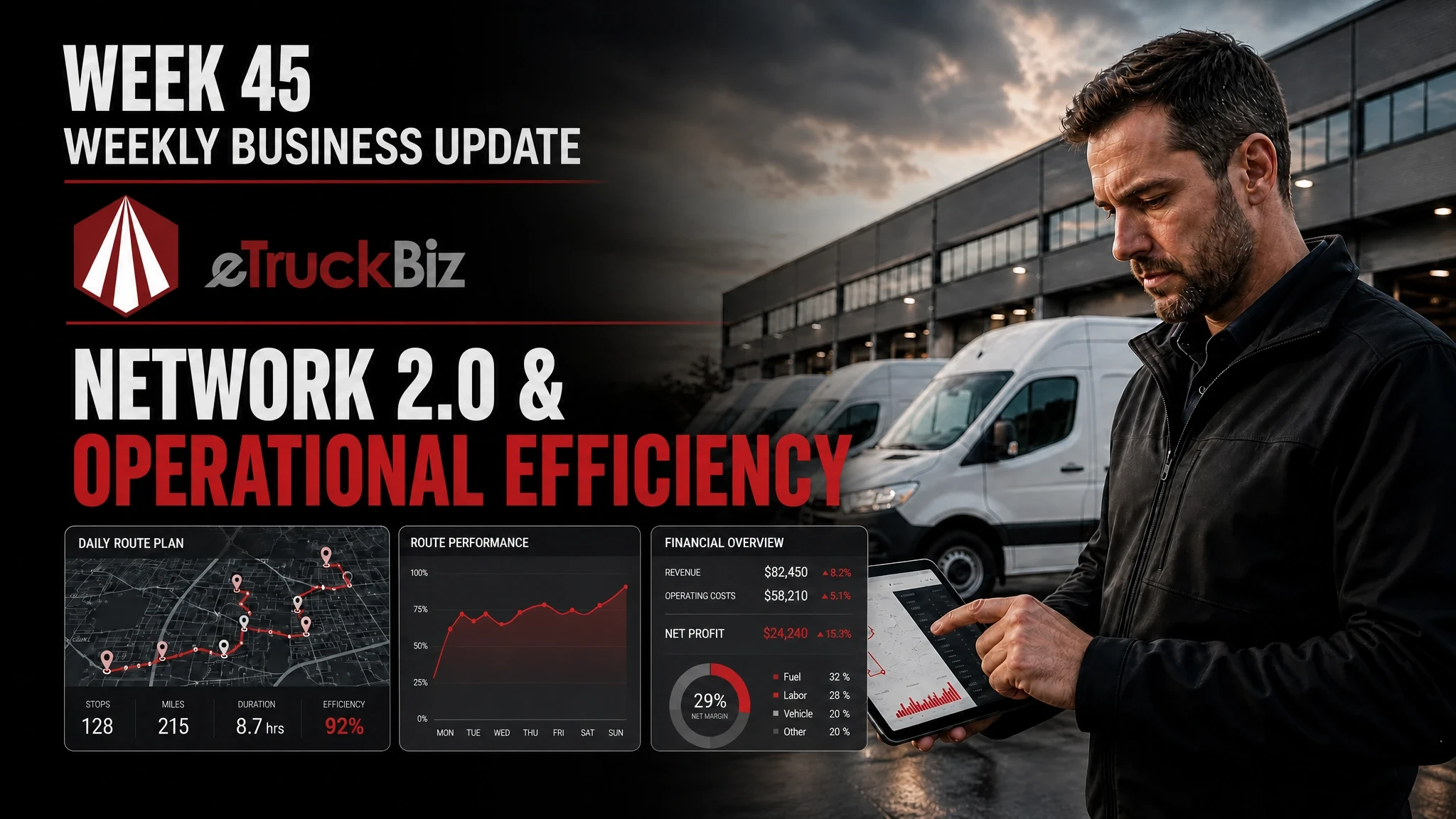
The efficiency assumption behind the economics
Our operating-model assessment for this discussion is that contractors should plan around achieving 80% or better efficiency, with consistently strong Gold contractors providing an operating reference. That is my practitioner assessment, not a claim that a published FedEx rule applies the same 80% formula to every contractor. Your actual model needs a defined efficiency measure, service-area assumptions, and applicable agreement terms.
That distinction matters because “efficiency” can mean several things. Stops per paid hour, stops per dispatch, route utilization, and an engineered work-standard index are not interchangeable. A Gold designation is not an efficiency percentage, and it is not a profit-and-loss statement.
The counterargument in our discussion is reasonable: if the model assumes something below 100%, it already allows for a degree of inefficiency. I am not saying every minute must be perfect. I am saying a limited allowance can be used up, and additional operating expense still has to be paid by someone.
For planning purposes, separate what the model assumes from what your operation delivers. Compare the workload, labor hours, vehicle requirements, geography, and service windows behind the plan with actual results. Do not assume that compensation increases dollar-for-dollar because your team needed more time.
eTruckBiz's Standard Budget approach is described as a simulation of cost assumptions reverse-engineered from contract-negotiation experience, with actual performance compared against a Standard Budget and Expense Plan (eTruckBiz). That is useful contractor-side analysis, not the same as possessing an official FedEx formula. The purpose is to expose the gap between what the business needs to achieve and how it is actually operating.
FedEx contractor efficiency and the learning-curve problem
A new owner, a new Business Contact, and a new driver all need time to learn. The business, however, must continue paying for the work while that learning takes place. That makes the learning curve a financial planning issue rather than a reason to lower training or safety standards.
A new owner may be learning which numbers deserve attention and which operating decisions create those numbers. A new BC may be learning dispatch engineering, communication, and intervention rather than simply filling open routes. A new driver must learn safe methods, the work area, service commitments, and when to ask for help.
The danger is expecting the economics of an experienced operation while funding the learning curve of an inexperienced one. If the allowance for inefficiency is already being consumed by normal operating variation, additional training hours and repeated mistakes can squeeze the owner's return quickly. A plan that acknowledges learning has to include both its cost and a method for improving performance.
Consider a separate hypothetical training example: five new drivers each require one additional paid hour a day for ten working days. At an assumed $35 fully burdened hourly cost, that is $1,750 in additional labor, before any separate trainer time. It is not automatically waste; the financial question is whether the training investment produces safe, sustained improvement rather than recurring indefinitely.
Recruiting difficulty makes that question more urgent. Ask whether the bottleneck is applicant flow, hiring conversion, or early retention, and whether each replacement restarts the same learning process. Hiring and retention, wage pressure, and culture have also been subjects of contractor discussion in 2026 (Route Consultant).
Jordan's experience will help make this concrete. We will ask what has become harder in his Maine recruiting market, how new drivers get up to speed, and what changed when wave dispatches were introduced. Those are questions for the interview, not conclusions about his results.
Why a modest efficiency decline can eliminate the profit
The financial effect is not proportionate to the size of the operating problem. Profit is the relatively small amount remaining after expenses, so an expense increase can consume a large share of it. If the same workload requires progressively more paid hours as efficiency falls, cost can rise nonlinearly as well.
Here is a deliberately simplified daily model. Revenue is $10,000, efficiency-sensitive labor costs $7,000 at an 80% efficiency index, and all other modeled operating expenses total $2,000. The initial operating profit is $1,000, before interest and income tax.
For this illustration only, define efficiency as standard work-hours divided by actual paid work-hours. Assume the fixed workload represents 160 standard hours under safe, compliant methods, including appropriate required allowances. At 80%, that requires 200 paid hours; an assumed flat, fully burdened labor cost of $35 per hour produces the $7,000 baseline.
This index is invented for the example, not identified as FedEx's efficiency metric. The model holds workload, revenue, service, safety, the hourly rate, and the $2,000 of other expense constant. It isolates labor-hour sensitivity rather than forecasting an actual contractor's cost structure.
| Illustrative efficiency index | Labor expense | Other expense | Total expense | Operating profit | Margin |
|---|---|---|---|---|---|
| 80% | $7,000.00 | $2,000.00 | $9,000.00 | $1,000.00 | 10.00% |
| 75% | $7,466.67 | $2,000.00 | $9,466.67 | $533.33 | 5.33% |
| 70% | $8,000.00 | $2,000.00 | $10,000.00 | $0.00 | 0.00% |
| 65% | $8,615.38 | $2,000.00 | $10,615.38 | −$615.38 | −6.15% |
The calculation is baseline labor cost multiplied by baseline efficiency divided by actual efficiency. At 70%, for example, labor expense is $7,000 × 80 ÷ 70, or $8,000. The other $2,000 remains unchanged.
Moving from 80% to 70% is a ten-percentage-point decline, or a 12.5% relative reduction in the efficiency index. Yet it eliminates 100% of the original profit in this example. The operation is still completing the same workload, but it is no longer producing an operating return.
At 65%, the operation loses approximately $615 per day. That is what I mean by effectively “subsidizing the work”: the business must cover a shortfall from reserves, financing, or owner capital rather than from revenue earned that day. This is an economic description, not a claim of a formal subsidy or a particular contractual violation.
Seventy percent is this example's break-even point, not an industry-wide threshold. Actual break-even depends on compensation, wages, workload, other costs, and the definition of efficiency. The relationship shown is disproportionate margin compression, not a mathematically exponential curve.
Real expenses may behave differently. Overtime premiums, additional vehicle requirements, or service problems can make the result worse, while unchanged daily pay may mean recovered time initially creates capacity rather than cash savings. Measure the expenses that actually change instead of assuming every productivity improvement immediately reduces payroll.
The solution is a culture of efficiency, not a demand to hurry
I have spent 30 years studying this problem across my FedEx and contractor-support work. My conclusion is that the answer is a repeatable operating method, not an owner repeatedly asking people to work harder. I look to the habits of long-time, consistently strong Gold contractors as a practical reference, without assuming that a medal proves profitability.
There is also a useful recent example in our own interview series: Chad Barnes described clearer expectations, daily review, BC accountability, and training as parts of his operation's improvement (eTruckBiz's Chad Barnes interview). His experience is not a forecast for another contractor. It does illustrate why the management routine deserves as much attention as the routing tool.
Leadership and communication
Leadership establishes the standard and provides accountability. The AO and BC need a common understanding of what the operation is trying to achieve, what resources are available, and when an exception requires action. A driver should not have to guess which informal preference takes priority today.
Communication turns that standard into a usable plan. Explain the assignment, service commitments, expected methods, and escalation process before departure. Drivers do not need the owner's entire financial statement, but they should understand that avoidable extra time and repeated rework affect the resources available for the whole team.
Make the expectations realistic for the work. Do not impose the same stop count on routes with different geography, package mix, or service windows. A target is useful when the team understands how to achieve it safely and what to do when the assumptions change.
Monitoring and recognition
Monitoring has two distinct jobs: intervene while there is still time to improve today's outcome, then learn from the completed day. OPTIX's listed capabilities include P&D productivity, delivery and pickup status, real-time critical exceptions, and time-definite stops and packages (P&D OPTIX listing). eTruckBiz describes its software as receiving real-time operational data through a direct FedEx connection (eTruckBiz software).
Data needs an owner and a response. Name who checks the operation, which exceptions deserve attention, and how the driver is contacted safely. The next-day discussion should explain why the gap occurred and what changes before the problem repeats.
Recognition reinforces the behavior you want repeated. My recommendation is to recognize specific, safe, productive work in front of peers and to include both individual improvement and team achievement. Money matters, but a bonus alone does not communicate the operating standard.
For example, recognize a driver who improved a package-handling method, communicated a developing problem early, and completed commitments safely. Recognize a team that reduced avoidable rescues without pushing work onto another group. Do not reward raw speed, hidden time, skipped breaks, or the concealment of incidents.
How eTruckBiz helps close the efficiency gap
The owner remains the leader; eTruckBiz provides guidance and supporting work to help the operation achieve a repeatable standard. PerformanceIQ's published scope includes dispatch engineering, BC-Assist, daily operations reviews, Virtual Methods Evaluations, and onsite evaluations (eTruckBiz PerformanceIQ). Those are practical mechanisms for identifying and correcting the causes of poor efficiency, not simply reporting that a number is low.
- Reengineer the work area: Examine route boundaries, stem miles, load balance, package capacity, and service commitments. Fix the design before assuming the driver is the problem.
- Prepare the AO and BC: Align financial targets with daily decisions and train the managers to interpret exceptions. Accountability must include the support and authority needed to act.
- Train drivers and build awareness: Teach safe, repeatable methods and explain how each person's work affects the operation. Recheck understanding rather than assuming that attendance at training equals mastery.
- Evaluate actual methods: Use contractor-led in-van observation or an appropriate remote review to identify unnecessary movement, searching, handling, or rework. eTruckBiz offers Virtual Methods Evaluations as a scheduled review of how drivers work their stops (PerformanceIQ).
- Monitor during the day: Use OPTIX's productivity and exception visibility to focus management attention while action remains possible (P&D OPTIX listing). Confirm the operating context before treating a number as a driver's failure.
- Follow up the next day: Pair the completed-day analysis with an assigned correction and follow-through. BC-Assist and daily operations review are part of the published PerformanceIQ program (PerformanceIQ).
- Recognize achievement: Make safe productivity, improvement, and team reliability visible. Tie recognition and awards to behaviors people can repeat, not circumstances outside their control.
For a methods example, assume a driver safely removes 30 seconds of unnecessary package searching at each of 120 comparable stops. That recovers one hour, without increasing driving speed or shortening required breaks. Whether it creates a cash saving, avoids overtime, or provides usable capacity depends on the pay arrangement and the remaining work.
Work-area engineering also includes deciding whether a wave-dispatch arrangement fits the operation. Separate driver groups and repeat trips have different costs; fewer waiting hours may be offset by additional stem miles, handoffs, or coverage. We will ask Jordan what problem his design addresses and how he evaluates the whole day, not just the first departure.
Putting It Together: A Framework for Closing the Efficiency Gap
- Define the financial requirement. Build the Standard Budget and Expense Plan around your service area's workload and constraints. Specify what “efficiency” means before applying a percentage or comparing operations.
- Budget for learning. Identify the support a new owner, BC, or driver needs and the cost of providing it. Establish safe progression checkpoints rather than assuming immediate experienced-level performance.
- Engineer and teach the work. Review the work-area design, dispatch plan, and driver methods together. Test wave dispatches against the total day's costs and commitments.
- Lead and communicate. Give the AO, BC, and drivers clear expectations, responsibilities, and escalation rules. Explain why the operating standard matters to the business and the team.
- Monitor now and review tomorrow. Use live information for timely intervention and completed-day analysis for cause and correction. Assign an owner to each change and verify the result.
- Recognize and sustain improvement. Celebrate safe productivity and team achievement with specific recognition and appropriate awards. Keep practices that improve the economics without sacrificing safety, service, or honest reporting.
A smooth-running, profitable operation is the objective, not a guaranteed outcome of a particular score or dispatch schedule. The practical path is to understand the economics, shorten avoidable learning, improve methods, and reinforce the standard every day. If you would like help connecting those pieces in your business, schedule a working session with eTruckBiz. The Right Service Provider Support, Right Now starts with identifying your efficiency gap and building a plan to close it.