
Three years ago, FedEx contracted with nearly 7,000 independent businesses for pickup, delivery, and linehaul. As of May 31, 2026, that number was approximately 5,300 — roughly 1,700 contractor businesses gone, a 24% reduction, while the packages kept getting delivered by the contractors who remained.. At the same time, FedEx had implemented Network 2.0 at about 360 U.S. locations and expects to complete the U.S. rollout by the end of calendar 2027. Consolidation is not slowing down. The contractors who are still here, and still growing, are being handed more dispatches, more volume, and more scrutiny.
One question comes up in almost every conversation we have with contractors: how do the ones who make it actually do it? They run the same trucks, deliver the same packages, answer to the same station, and work under the same ISP Agreement. Yet some of them take a real vacation, grow into a second and third CSA, and eventually sell for a strong number, while others are answering driver texts at 5:00 a.m., conjuring up the latest pay plan for the third time this year, and finding out how the month went, well, maybe never.
The difference is almost never effort. It is business structure — a proven set of processes, followed the same way, every day, until they become the way the business runs. This post makes the case for structure using examples from medicine, aviation, manufacturing, franchising, and transportation, shows what structure is worth in dollars on a real 10-route CSA, and then walks through how the eTruckBiz Business Growth & Support System puts that structure in place.
What Business Structure Actually Means for a FedEx Contractor
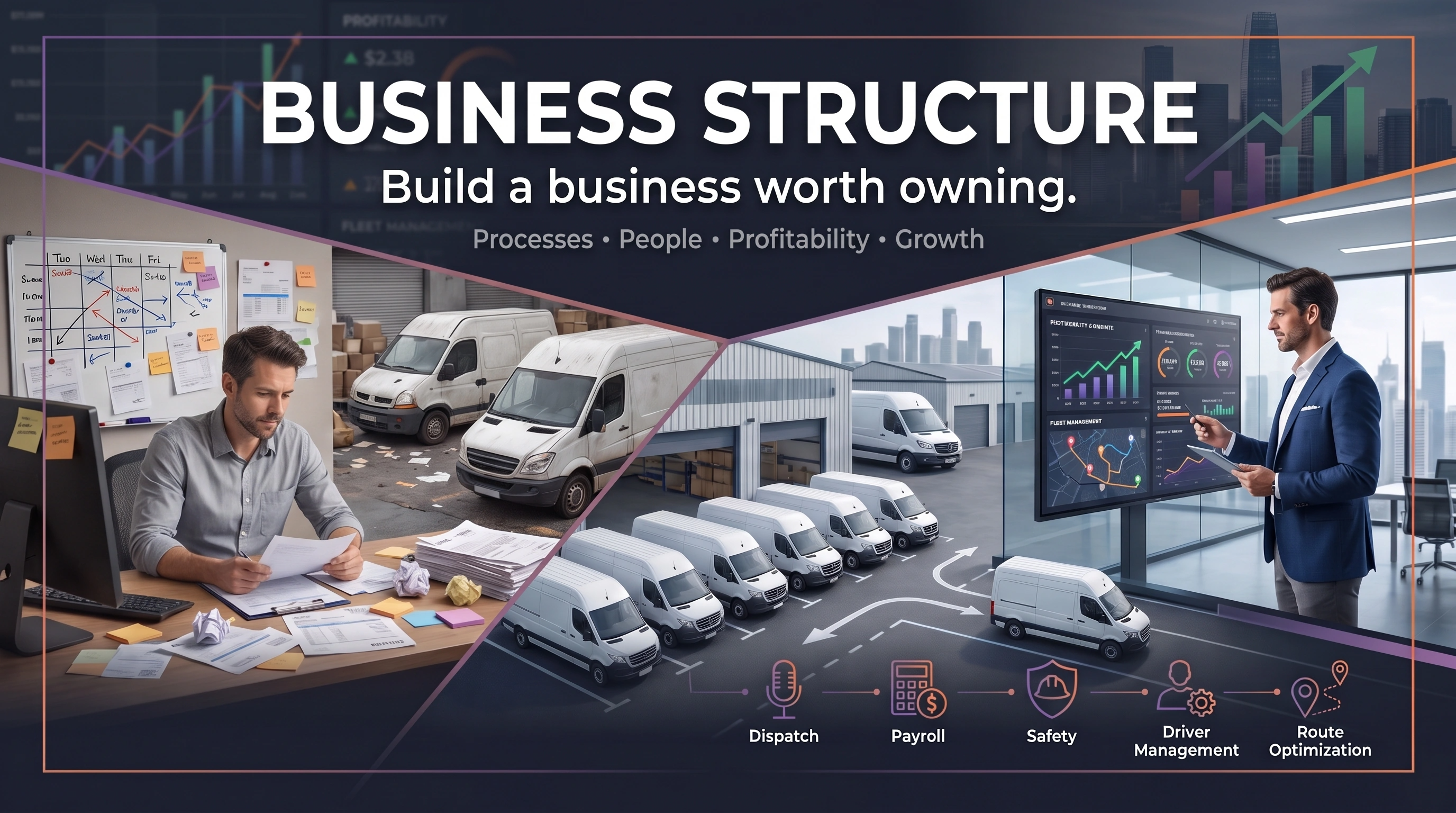
Structure is not a binder on a shelf or an org chart nobody reads. For a FedEx CSP, business structure means adopting processes that are already proven to work and then running them over and over — the same dispatch decision process every morning, the same timekeeping review every day, the same onboarding sequence for every new driver, the same daily look at dispatch yield, the same response to every VEDR event. Structure is repeating what works.
The opposite is not freedom. It is improvisation. Every decision gets made from scratch, usually by the owner, usually under pressure, and usually differently than the last time. That is exhausting, and it is expensive, because every decision made from scratch is a decision that can be made wrong.
Michael Gerber built an entire business philosophy around this idea in The E-Myth Revisited. His argument is that most small businesses fail because their owners think like technicians rather than business owners, and that the fix is a systems-driven "franchise prototype" — a business that is systems-dependent, not people-dependent (Graham Mann, E-Myth book notes). A FedEx CSP owner who is the only person who knows how dispatch gets built, how payroll gets checked, and which driver can handle which route has built a people-dependent business. The people it depends on is them.
There is one more thing structure is not: permanent. Toyota, the company that built the modern playbook for operating discipline, treats standard work and continuous improvement as a pair. As Taiichi Ohno put it, "Standardized work at Toyota is a framework for kaizen improvements" (Lean Enterprise Institute). You cannot improve a process you do not run consistently, because you have no baseline to measure against. A business that changes its approach every few weeks is not improving. It is guessing.
Why Structure Matters: Lessons From Other Industries
Contractors are right to be skeptical of business advice imported from other industries. But the pattern below shows up everywhere high stakes meet repetitive work, and the results are measured, not theoretical.
Medicine: A 19-Item Checklist
In 2007 and 2008, a World Health Organization program tested a simple 19-item surgical safety checklist in eight hospitals around the world, from high-income cities to rural facilities. The surgeons did not get new equipment or new skills. They got a consistent process. Inpatient complications fell from 11.0% to 7.0%, and the death rate fell from 1.5% to 0.8% (New England Journal of Medicine, 2009). Highly trained professionals made fewer costly mistakes simply because the critical steps were followed the same way every time.
The lesson for a CSP is direct. Your drivers do not need to be surgeons to benefit from the same principle. A consistent pre-trip, a consistent stop approach, a consistent end-of-day process — each one removes a category of preventable error that otherwise shows up as a claim, a safety event, or a service failure.
Aviation: Checklists After a Crash
Aviation adopted the pre-flight checklist after a new, highly complex bomber crashed during a 1935 demonstration flight with an experienced test pilot at the controls. Once pilots started using checklists, certain kinds of accidents dropped drastically (SIGPLAN, on the Checklist Manifesto). The problem was never skill. The aircraft had become too complex for memory and good intentions. A multi-route FedEx operation in Network 2.0, with Express and Ground volume, compliance requirements, VEDR, and payroll across dozens of drivers, is well past the point where memory and good intentions work.
Franchising: A Head Start From Borrowed Structure
Franchising is essentially buying a proven structure. University of Michigan research using U.S. Census data found the one-year survival rate for new franchised businesses was about 6.3 percentage points higher than for independents, and the two-year rate 8.4 points higher, with the franchisor's business knowledge and brand contributing to the advantage (Michigan Ross). The same research carries a caution worth hearing: the advantage is concentrated in the first year or two and fades after that. Borrowed structure gets you through the dangerous early period. After that, what matters is whether you actually keep running it.
Transportation: UPS and Southwest
Our own industry offers the clearest examples. UPS has run its drivers on the "340 Methods" since the 1920s, specifying the most efficient way to do nearly everything on route. Its policy of minimizing left turns — roughly 90% of UPS truck turns are right turns — is credited with saving more than 10 million gallons of fuel over a decade (Harvard Business Review). No single right turn saves much. Doing it the same way, millions of times, saves a fortune.
Southwest Airlines built its cost advantage on one aircraft type. A single fleet type lets any pilot fly any aircraft, reduces spare parts inventory, and cuts training time and cost (Wikipedia, Southwest Airlines). The CSP equivalent is standardizing what can be standardized — vehicle specs, driver onboarding, pay structure, dispatch engineering — so that every new dispatch, driver, or station plugs into something that already works instead of creating a new variation to manage.
What It Looks Like to Run a CSA Without Structure
Most contractors who lack structure did not choose chaos. They bought or started a business, got busy delivering, and built the operation one emergency at a time. Here is what that looks like from the inside:
- Dispatch gets built each morning by gut feel, based on who showed up or not, not on what each route costs to run
- The driver pay plan has changed two or three times this year, and drivers talk about it
- New driver onboarding depends on who has time that week, so a third of new hires are gone before 90 days
- Timekeeping gets checked when someone complains, and payroll errors get found after the money is gone
- VEDR events get reviewed when there is time, defeating the building of culture of safety
- A second station runs its own way, because its manager has their own "best way"
The financial cost of that picture is real, but the personal cost is what most owners feel first. When every decision flows through the owner, the owner cannot leave. There is no vacation, no time to work on growth, and no margin for error when a driver quits on a Monday in November. Our data shows Service Provider driver turnover running 30–40% annually, with roughly a third of new hires gone before they reach the 90-day mark. In an unstructured business, every one of those departures is a fire the owner personally puts out.
Ask yourself honestly:
- If you were unreachable for two weeks, would dispatch, payroll, and safety review still happen correctly?
- Could you hand a new manager a written process for each of those, or is it in your head?
- Do you know your dispatch yield today?
- Has your pay plan, onboarding process, or dispatch approach changed more than twice in the past year?
What Structure Is Worth in Dollars
Structure shows up on the P&L and again on the sale price. Take a 10-route CSA doing $1.8 million in annual revenue with 15 drivers and an EBITDA margin of 10%, or $180,000. The figures below are illustrative assumptions, not benchmarks, but each one is a cost we see regularly in operations that run without consistent process.
|
Leakage in an unstructured CSA |
Assumption |
Annual cost |
|
Unnecessary dispatches |
2 per week at $375 each (driver, vehicle, fuel) |
$39,000 |
|
Excess driver turnover |
4 extra replacements a year at $5,000 each (recruiting, Qual Cert time, training, early-tenure productivity) |
$20,000 |
|
Timekeeping and payroll leakage |
1.5% of an $810,000 driver payroll |
$12,150 |
|
Preventable claims and safety events |
One avoidable incident a year |
$10,000 |
|
Total |
$81,150 |
Recover that $81,150 and EBITDA moves from $180,000 (10.0%) to $261,150 (14.5%). Structure is not free, whether you build it yourself or bring in help, so be honest about the cost. Even after spending $35,000 a year on it, EBITDA still lands at $226,150 — a 12.6% margin and $46,150 more in the owner's pocket every year.
Now look at what happens at sale. FedEx route businesses typically trade at about 3x–5x EBITDA, and buyers are paying more for well-documented operations, clean settlement history, and a professional driver team, while businesses with tight margins or high turnover sell at a discount. Outside our industry, Value Builder research found businesses that could run without the owner were valued at roughly 4.49x pre-tax profit, versus 2.93x where the owner was the hub of every relationship (Duran Advisors, citing the Value Builder System).
Apply that to our CSA:
- Unstructured, owner-dependent: $180,000 × 3.0 = $540,000
- Structured, net of the $35,000 cost: $226,150 × 4.0 = $904,600
That is a $364,600 difference in what the same routes, the same trucks, and the same station are worth. Even if both businesses sold at the same 3.5x multiple, structure alone adds 161,525 of value (791,525 versus $630,000). The multiple difference is where structure pays twice: once in annual margin, and again when a buyer decides how much risk they are taking on.
What It Looks Like With Structure: The eTruckBiz Business Growth & Support System
The Business Growth & Support System (BGSS) is how eTruckBiz works with contractors to provide structure. It is not a menu of disconnected tools. It is one platform coordinating four programs, each with its own recurring review work, so the processes that make a CSA run well happen the same way every day whether or not the owner is in the building.
One Platform: BOSS
Every BGSS program runs on BOSS, our Business Operations Support Software. BOSS includes driver route optimization, a driver app, and a live connection to FedEx operational data through our real-time FedEx API connection — one of only four such connections. That matters for structure because a process is only as good as the information feeding it. When everyone works from the same current data, dispatch, performance, safety, and payroll decisions stop depending on whose spreadsheet is newest.
Four Programs, One Source of Truth
AdminIQ — Not software that helps you do it, a team that does it. Our onshore admin team handles daily timekeeping review, daily payroll processing, and continuous recruiting. eTruckBiz processes well over $200 million in annual payroll for contractors. This is the non-revenue-producing work that eats an owner's week, done the same way every day. In our CSA example, this is where the timekeeping and turnover leakage gets addressed.
BudgetIQ — Not a budget built once a year, your numbers, current every day. Your dispatch-yield report is reviewed every morning at 8:45 a.m. Central. Instead of discovering an unprofitable dispatch pattern later, you see it the day after it happens. This is so unnecessary dispatches are not repeated.
PerformanceIQ — Not more effort, a way of running that works without you in the building. PerformanceIQ sends a daily operations report and performs same-day live or stop-time reviews when the numbers call for it. BC Assist gives your Business Contact experienced guidance behind them for the difficult operating problems.
SafetyIQ — Not just an incident count, what safety is costing or saving you, in dollars. VEDR events are reviewed daily, documentation is generated for FedEx safety KPI compliance, and coaching follows the events that need it. Safety becomes a daily routine instead of a reaction to a call from the station.
Structure Delivered by People, Not Just Software
Structure fails when nobody owns it. BGSS clients work with four coordinated contacts: an Administrative Services Manager with an onshore admin team, a financial analyst, a safety program lead, and one account owner accountable for the number. For new contractors, we recommend starting BGSS at least 30 days before standup, so the operating and financial plans are finished before the first truck rolls and the owner can focus on drivers from day one.
For multi-station contractors, this is the piece that matters most. Operations break down across facilities when there is no shared structure. Separate local "best ways" do not add up to one consistent business, and a buyer looking at three stations run three different ways sees three risks, not one asset.
Putting It Together: A Framework for Building Business Structure
- Write down what already works. Start with the four processes that touch money every day: dispatch, timekeeping and payroll, driver onboarding, and safety event review. If it only exists in your head, it is not structure yet.
- Pick one way and hold it. Choose the best current version of each process and run it the same way for 90 days before changing anything. Consistency creates the baseline you need to improve.
- Put each process on a clock. Structure has a rhythm — dispatch yield reviewed every morning, timekeeping reviewed every day, VEDR events reviewed every day, performance reviewed every week. A process without a time slot gets skipped.
- Assign an owner who is not you. Every recurring process needs a named person accountable for it. The goal is a business that runs correctly for two weeks without you.
- Measure in dollars. Track what each process protects: dispatch yield, overtime hours, 90-day driver retention, claims cost. What gets measured in dollars gets managed.
- Improve on purpose, not in a panic. Change a process because the numbers show a better way, not because last week was hard. Document the change so everyone runs the new version.
- Build for the buyer. Run the business as though someone will review your settlements, payroll records, and safety documentation tomorrow. That is how margin becomes value.
Network 2.0 is consolidating the network and concentrating volume in fewer, stronger contractors, and the ones left standing in 2027 will be the ones whose businesses run the same way every day. Structure is how you relieve the stress of doing everything yourself, how you protect margin one repeated decision at a time, and how you turn a contract into an asset a buyer will pay for.
eTruckBiz Inc. works with hundreds of FedEx Service Providers to put proven operating, financial, safety, and administrative structure in place through the Business Growth & Support System. If you'd like to see where structure would make the biggest difference in your operation, schedule a working session or request a Profit Gap Analysis. That is what we mean by The Right Service Provider Support, Right Now.